
Introduction
In the vibrant heart of Bavaria, a football rivalry transcends mere sport, embodying a deep-seated cultural and social divide. This is the story of the Munich derby football, a clash between FC Bayern Munich and TSV 1860 Munich, a rivalry that has shaped the city’s sporting identity for over a century. While one club has ascended to global superstardom, the other remains rooted in local tradition, creating a narrative of stark contrasts.
The Munich derby is more than just a game; it’s a battle for bragging rights, a reflection of differing philosophies, and a testament to the enduring passion of football fans. For decades, it was one of Germany’s most heated encounters, pitting neighbour against neighbour and friend against friend. This post delves into the rich tapestry of this unique rivalry, exploring its origins, its most memorable moments, and its lasting legacy.
Origins of the Rivalry: A Tale of Two Clubs
The roots of the Bayern vs 1860 rivalry trace back to the early 20th century, long before professional football became a global phenomenon. TSV 1860 Munich, founded in 1860 as a gymnastics club with a football department established in 1899, often presented itself as the city’s original and more traditional club. They were seen as the club of the working class, deeply embedded in the local community and proud of their “Löwen” (Lions) nickname.
FC Bayern Munich, founded in 1900 by members of a gymnastics club who broke away, quickly established itself as a formidable force. Initially, Bayern was perceived by some as the club of the “Schickeria” – a more affluent, academic, or “posh” segment of Munich society. This early social distinction laid the groundwork for a rivalry that went beyond the pitch, often reflecting the city’s socio-economic nuances.
In the pre-Bundesliga era, both clubs enjoyed periods of success, vying for regional and national honours. 1860 Munich claimed their first German championship in 1942, while Bayern secured theirs in 1932. However, it was the advent of the Bundesliga in 1963 that truly ignited the rivalry. Both clubs were founding members, and for a glorious period in the 1960s, they were genuine equals, competing fiercely for domestic supremacy. This golden age saw 1860 win the Bundesliga title in 1966, famously beating Bayern to the coveted trophy, and Bayern achieve its first significant European success.
Cultural & Social Impact: Dividing a City
The Munich derby football rivalry deeply permeated the city’s cultural and social fabric. It wasn’t merely about ninety minutes of football; it was about identity, pride, and a fundamental choice of allegiance. Munich, a city renowned for its beer gardens and Oktoberfest, also became a city divided by football allegiances, with streets, pubs, and even families often split down the middle.
- Fan Identity: 1860 fans, known as “Löwen” (Lions), often identify with a sense of underdog spirit, resilience, and deep-rooted tradition. Bayern fans, “Die Roten” (The Reds), embody success, ambition, and global recognition.
- Chants and Banners: Derby days were marked by creative, often provocative, chants and banners from both sets of supporters. These often poked fun at the other club’s perceived shortcomings or celebrated their own history and achievements.
- Stadium Sharing: The shared use of iconic venues like the Olympiastadion and later the Allianz Arena, though controversial, further intensified the rivalry. For 1860 fans, playing in Bayern’s home (the Allianz Arena) felt like an invasion, yet it also provided a stage for their defiance.
- Local Bragging Rights: The outcome of the derby determined who held the city’s bragging rights until the next encounter. For 1860, a victory against their dominant neighbours was often considered a “title” in itself, regardless of their league position.
Despite Bayern’s global stature, the historical and emotional connection to 1860 remains significant for many in Munich. The rivalry has fostered a unique dynamic where one club’s global success is a constant reminder of the other’s local struggle, yet both contribute to the rich footballing tapestry of the Bavarian capital.
Historic Matches & Moments: Derby Day Drama
The Bayern vs 1860 rivalry has produced countless memorable matches, filled with drama, passion, and unforgettable moments. These encounters are etched into the folklore of both clubs, defining eras and shaping narratives.
The Golden Sixties: When 1860 Ruled
- 1964 DFB-Pokal Final: While not a direct derby, 1860 Munich won the DFB-Pokal, signifying their rise just as Bayern were also establishing themselves. This set the stage for intense league battles.
- 1965-66 Bundesliga Season: This was arguably the peak of 1860″s success and a pivotal moment in the rivalry. 1860 Munich, under the legendary Max Merkel, clinched the Bundesliga title, finishing three points ahead of Bayern. The derbies that season were fiercely contested, with 1860 winning the home fixture 1-0 and drawing the away game 1-1. This title remains a source of immense pride for 1860 supporters.
- 1966-67 European Cup Winners” Cup: Bayern Munich went on to win this European trophy, a sign of their burgeoning power, even as 1860 were domestic champions. This period saw both clubs at the pinnacle of German football.
Later Bundesliga Encounters: Moments of Upsets
Even as Bayern began to assert their dominance from the 1970s onwards, 1860 always fought hard in the derby. There were several instances where the “Löwen” managed to defy expectations:
- 1999-2000 Season: 1860 Munich famously completed a “derby double” over Bayern, winning both Bundesliga encounters (1-0 and 2-1). This was a rare achievement and a huge morale boost for the blue half of the city, especially as Bayern went on to win the league that year.
- 2003-04 Season: The last Bundesliga derbies saw 1860 lose 1-0 in November 2003, and April 2004. These were the final top-flight clashes before 1860″s relegation.
DFB-Pokal Clashes: Keeping the Flame Alive
With 1860″s relegation from the Bundesliga in 2004, competitive derbies became rare. The DFB-Pokal has since provided the only stage for these encounters, keeping the rivalry alive:
- 2007-08 DFB-Pokal Quarter-final: A highly anticipated match saw Bayern win 1-0 after extra time, with Franck Ribéry scoring the decisive goal. It was a tense affair that showcased the enduring passion of the derby.
These matches, though few and far between in recent decades, serve as powerful reminders of the deep history and emotional significance of the Munich derby football.
Legendary Players & Managers: Defining the Rivalry
The Bayern vs 1860 rivalry was often defined by the iconic figures who graced the pitch and the sidelines. These individuals not only shaped their respective clubs but also left an indelible mark on the derby’s narrative.
TSV 1860 Munich Icons: The “Löwen” Heroes
- Max Merkel (Manager): The architect of 1860″s Bundesliga title in 1966, Merkel was a charismatic and controversial figure. He instilled a fierce winning mentality in his team, making them genuine contenders against Bayern.
- Rudi Brunnenmeier (Striker): A prolific goalscorer and captain during 1860″s golden era, Brunnenmeier was the embodiment of the club’s fighting spirit. He was a constant threat to Bayern’s defence.
- Petar Radenković (Goalkeeper): “Radi” was a Yugoslavian showman and a fan favourite. His flamboyant style and crucial saves made him a legend, often frustrating Bayern’s attackers.
- Manfred Bender (Midfielder): A key player in 1860″s more recent successful Bundesliga years, known for his leadership and powerful free-kicks.
FC Bayern Munich Legends: The Rise of a Dynasty
Bayern’s legends are numerous, but some were particularly influential during the peak of the Munich derby football:
- Franz Beckenbauer (“Der Kaiser”): Emerging from Bayern’s youth academy, Beckenbauer became the face of German football. His elegance and leadership were instrumental in Bayern’s rise, often overshadowing 1860″s efforts.
- Gerd Müller (“Der Bomber”): The ultimate goalscorer, Müller’s clinical finishing was a constant threat to 1860. His goals often decided derby matches in Bayern’s favour.
- Sepp Maier (Goalkeeper): Bayern’s legendary goalkeeper, known for his agility and humour, was another key figure from the golden generation who experienced the intense derby atmosphere.
- Udo Lattek (Manager): Lattek managed Bayern during multiple successful spells, often guiding them to victory over 1860.
While direct transfers between the clubs became less common as Bayern’s star rose, the rivalry was deeply personal for players who grew up in Munich and understood the significance of the derby. Their performances and personalities further fuelled the intense atmosphere.
Statistics & Records: A Tale of Two Fortunes
The historical statistics of the Munich derby football paint a clear picture of Bayern Munich’s eventual dominance, especially in the modern era. However, they also highlight 1860″s periods of strength and their ability to spring surprises.
Head-to-Head Competitive Record (Bundesliga, DFB-Pokal, Regional Championships):
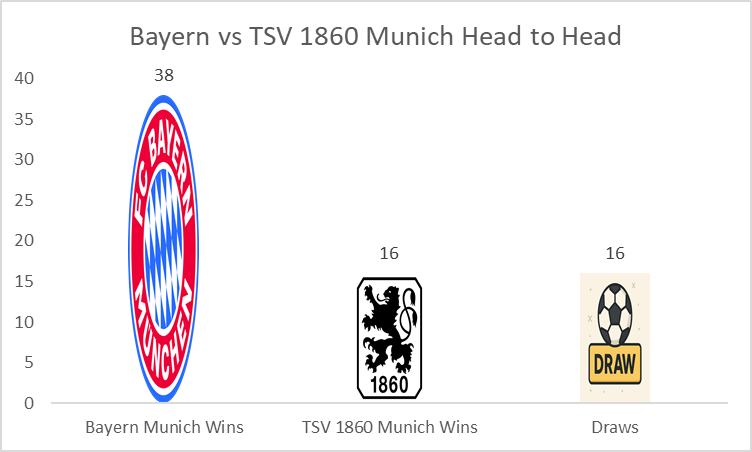
Bundesliga Specific Record (38 Matches):
- Bayern Munich Wins: 21
- TSV 1860 Munich Wins: 8
- Draws: 7
- Goals for Bayern: 64
- Goals for 1860: 41
Notable Records:
- Biggest Bayern Win: 6-1 (Bundesliga, 1980)
- Top Scorer in Bundesliga Derbies: Gerd Müller (Bayern) with 10 goals.
- Last Bundesliga Derby: April 2004, Bayern Munich 1-0 TSV 1860 Munich.
- Last Competitive Derby: September 2008, Bayern Munich 1-0 TSV 1860 Munich (DFB-Pokal, AET).
Trophy Cabinet Comparison:
- FC Bayern Munich:
- Bundesliga: 34
- DFB-Pokal: 20
- UEFA Champions League: 6
- Other major European/World titles: 5
- TSV 1860 Munich:
- Bundesliga: 1 (1966)
- DFB-Pokal: 2 (1942, 1964)
These statistics clearly illustrate Bayern’s incredible rise to become one of the most successful clubs globally, while 1860, after its initial successes, struggled to maintain its top-tier status. The gap in trophy count is staggering, reflecting divergent paths since the 1970s.
The Modern Era: A Rivalry on Hold?
The Munich derby football has undergone a dramatic transformation in the modern era. While the historical animosity and cultural divide persist, direct competitive encounters have become increasingly rare, largely due to 1860 Munich’s decline and Bayern’s unprecedented ascent.
1860″s Struggles:
Since their relegation from the Bundesliga in 2004, 1860 Munich has endured a tumultuous period. Financial difficulties, frequent changes in management and ownership, and a lack of consistent sporting success have seen them drop as low as the fourth-tier Regionalliga Bayern in 2017. They have since managed to return to the 3. Liga, where they currently compete, but the Bundesliga remains a distant dream.
Bayern’s Global Dominance:
In stark contrast, FC Bayern Munich has solidified its position as a global footballing powerhouse. They have consistently dominated the Bundesliga, won multiple Champions League titles, and boast a star-studded squad. Their financial might and sporting success have made them one of the most recognizable brands in world football.
The Allianz Arena Chapter:
A significant, and often contentious, aspect of the modern rivalry was the shared use of the Allianz Arena. Built for the 2006 World Cup, it became the home ground for both clubs in 2005. For 1860 fans, playing in a stadium co-owned and later fully owned by their dominant rivals was a constant source of frustration and a symbol of their club’s struggles. In 2017, 1860 Munich terminated their rental agreement and moved back to their traditional Grünwalder Stadion, a move celebrated by many “Löwen” as a return to their roots and identity.
Rare Encounters:
Today, the Bayern vs 1860 rivalry is primarily sustained through youth team matches, pre-season friendlies, and the occasional DFB-Pokal draw. These infrequent competitive clashes, such as the 2008 and 2014 DFB-Pokal ties, become highly charged events, demonstrating that despite the league disparity, the passion for the derby remains undimmed among the fans. For many 1860 supporters, these games offer a rare chance to measure themselves against their illustrious neighbours and to dream of a return to former glories.
The Future of the Rivalry: A Lingering Hope
What does the future hold for the Munich derby football? For now, direct competitive clashes at the highest level remain a rarity. However, the emotional resonance and historical significance of the Bayern vs 1860 rivalry ensure it will never truly fade away. The rivalry lives on in the hearts of the fans, in the city’s pubs, and in the storytelling of generations.
1860″s Aspirations:
For 1860 Munich, the primary goal is to achieve promotion back to the 2. Bundesliga and, eventually, to the top flight. A return to the Bundesliga would not only signify a sporting resurgence but would also reignite the full intensity of the derby. The club”s passionate fanbase continues to hope for a future where the “Löwen” can once again challenge Bayern on a regular basis, much like in the golden era of the 1960s.
Bayern’s Perspective:
For Bayern, while 1860 is no longer a direct competitor, the historical rivalry is acknowledged and respected. Many older Bayern fans remember the fierce battles and understand the importance of 1860 to the city’s football identity. A strong 1860 would undoubtedly add another layer of excitement and local flavour to German football, even for Bayern supporters.
The Enduring Spirit:
The rivalry persists through shared history, contrasting identities, and the unwavering loyalty of supporters. Even without regular derbies, the narrative of the “little brother” versus the “global giant” continues to shape football discourse in Munich. The romantic notion of 1860″s eventual return to the top flight, and the full-blooded resumption of the derby, remains a powerful dream for many.
The Munich derby football is a testament to the enduring power of local football rivalries, even when the playing field is far from level. It’s a story of hope, resilience, and the unyielding spirit of football fans.
Conclusion: The Lasting Importance of the Munich Derby
The Munich derby football between FC Bayern Munich and TSV 1860 Munich is a rivalry unlike many others. It’s a tale of two clubs born in the same city, one soaring to unprecedented global heights, the other battling to reclaim its former glory. From the fiercely contested Bundesliga titles of the 1960s to the rare, emotionally charged DFB-Pokal encounters of today, the derby has always been more than just a game; it’s a mirror reflecting Munich’s social fabric and footballing soul.
While the statistics clearly favour Bayern in the modern era, the spirit of the Bayern vs 1860 rivalry remains deeply embedded in the city’s culture. It’s a rivalry built on history, class distinctions, and an enduring sense of local pride. The longing for the “good old days” where both clubs competed as equals is a sentiment cherished by many, and the hope for 1860″s resurgence continues to fuel the passion of its loyal fanbase.
Ultimately, the Munich derby stands as a powerful reminder of how football rivalries transcend mere sport, becoming an integral part of a city’s identity. It’s a story of contrasts, resilience, and the undying hope that one day, the “Löwen” will once again roar loud enough to challenge the “Reds” on the grandest stage, rekindling the full fire of one of Germany’s most compelling football sagas.

