
In the vibrant tapestry of Spanish football, few rivalries burn with the unique intensity and cultural depth of the Basque derby football clash between Athletic Club Bilbao and Real Sociedad. More than just a game, it’s a contest that encapsulates regional pride, distinct football philosophies, and a shared identity that paradoxically fuels one of the sport’s most compelling narratives.
This isn’t merely about three points; it’s about bragging rights across two provinces, Bizkaia and Gipuzkoa. It’s a battle fought with passion, skill, and an underlying respect that makes the Basque derby a truly special spectacle for fans worldwide. As we delve into its rich history, cultural significance, and modern dynamics, we’ll uncover why this particular rivalry continues to captivate.
Origins of the Rivalry: A Shared Beginning, Divergent Paths
The roots of the Basque derby football rivalry stretch back to the early 20th century, a formative period for football across Spain. Both Athletic Club and Real Sociedad were founded within a decade of each other, Athletic in 1898 and Real Sociedad in 1909. They emerged from the industrial and port cities of Bilbao and San Sebastián, respectively, quickly becoming symbols of their communities.
Initially, both clubs shared a similar philosophy, drawing exclusively from local talent. This commitment to “cantera” (youth academy) football was a defining characteristic. However, their paths began to diverge notably in the latter half of the 20th century, particularly concerning player recruitment.
Athletic Club famously adopted and rigorously maintained its “Basque-only” policy. This unique stance dictates that only players born or raised in the Basque Country, or those who have come through a Basque club’s academy, can represent the Lions. This policy has become a cornerstone of their identity, a source of immense pride, and a constant challenge in modern football.
Real Sociedad, while deeply committed to its youth academy (Zubieta), eventually relaxed its strict Basque-only policy in the late 1980s. This decision allowed them to sign foreign players, broadening their recruitment pool and, arguably, leading to more diverse tactical approaches over the years. This divergence in philosophy has added another layer of intrigue and distinction to the Basque derby football rivalry, highlighting two different paths to success within a shared cultural framework.
Cultural & Social Impact: More Than Just a Game
The Basque derby football transcends the boundaries of the pitch, deeply embedding itself within the social and cultural fabric of the Basque Country. It’s a manifestation of provincial pride, a friendly yet intense competition between Bizkaia and Gipuzkoa, two of the region’s most prominent provinces.
Regional Identity and Pride
For fans, the derby is a chance to assert their regional identity and the superiority of their club. Bilbao, with its industrial heritage and larger population, often sees itself as the economic heart of the Basque Country. San Sebastián, a picturesque coastal city, is known for its beauty, gastronomy, and a slightly more cosmopolitan feel. These subtle regional distinctions play out passionately during derby week.
Despite the fierce competition, there’s an underlying sense of shared Basque identity that often leads to a unique atmosphere. Unlike many other rivalries marred by animosity, the Basque derby often features moments of mutual respect and even camaraderie between fan bases, particularly when it comes to celebrating their shared culture or supporting the wider Basque region.
Fan Traditions and Atmosphere
The build-up to a Basque derby football match is palpable. Cities are adorned with club colours, and conversations inevitably turn to tactics, player form, and predictions. On match day, both the San Mamés (Bilbao) and Anoeta (San Sebastián) stadiums become cauldrons of noise and colour. Chants in Euskera (the Basque language) fill the air, creating an authentic and electrifying atmosphere.
- Aste Nagusia vs. Semana Grande: While not directly football-related, the annual festivals in Bilbao (Aste Nagusia) and San Sebastián (Semana Grande) reflect the distinct cultural celebrations that feed into the local pride evident in the derby.
- Shared Celebrations: It’s not uncommon to see rival fans sharing drinks before or after a match, a testament to the respectful nature of the rivalry. However, once inside the stadium, all bets are off, and loyalty is absolute.
- The “Fair Play” Rivalry: While intense, the derby is rarely marred by major crowd trouble. This “fair play” ethos is often cited as one of the derby’s most admirable qualities, reflecting a mature and passionate football culture.
The outcome of a derby match can dictate the mood of an entire city for weeks. A victory brings immense joy and bragging rights, while a defeat can cast a shadow, but never diminish the underlying passion for their respective clubs.
Historic Matches & Moments: Defining Encounters
Throughout its long history, the Basque derby football has produced countless memorable matches, moments of triumph, heartbreak, and pure footballing drama. These encounters often transcend the league table, becoming etched in the collective memory of both fan bases.
The Golden Era of the 1980s
The early 1980s saw both Athletic and Real Sociedad dominate Spanish football, creating an unprecedented period of intense rivalry at the very top. Real Sociedad won back-to-back La Liga titles in 1980-81 and 1981-82, followed by Athletic Club winning their own back-to-back titles in 1982-83 and 1983-84, including a Copa del Rey in ’84. This era epitomized the Basque Country’s strength in Spanish football and made every derby a potential title decider.
- 1980-81 La Liga Decider: Real Sociedad clinched their first-ever La Liga title on the final day, famously drawing at Sporting Gijón. This period saw them consistently battling Athletic for supremacy, with the derby matches often dictating the league’s direction.
- 1982-83 La Liga Decider: Athletic Club’s triumph was hard-fought, and their derby clashes against Real Sociedad were pivotal. The tension and quality of football during this era were unparalleled.
The Copa del Rey Final of 2020 (Played 2021)
Perhaps the most significant Basque derby football match in recent memory was the 2020 Copa del Rey final, postponed due to the COVID-19 pandemic and finally played in April 2021. This was an unprecedented all-Basque final, a dream scenario for the region, even if played without fans.
Real Sociedad, under Imanol Alguacil, emerged victorious with a 1-0 win, thanks to a Mikel Oyarzabal penalty. It marked Real Sociedad’s first major trophy in 34 years and was a moment of immense pride for the Txuri-Urdin. For Athletic, who also reached the 2021 Copa del Rey final (losing to Barcelona), it was a bitter pill to swallow, losing to their fiercest rivals on such a grand stage.
Other Notable Encounters
- High-Scoring Thrillers: Matches like Athletic’s 4-2 win in 2005 or Real Sociedad’s 5-0 hammering in 1995 stand out for their goal-laden action. These games showcase the attacking flair often present in the derby.
- Emotional Comebacks: The derby has witnessed numerous dramatic comebacks, with teams often fighting to the last minute, reflecting the never-say-die attitude ingrained in both clubs.
Legendary Players & Managers: Derby Icons
Over the decades, numerous individuals have left an indelible mark on the Basque derby football rivalry, becoming legends for their respective clubs and, in some cases, for the region as a whole. Their performances, loyalty, and passion have defined the derby’s spirit.
Athletic Club Legends
- Telmo Zarra: Athletic’s all-time top scorer, a prolific striker whose goals often decided derby encounters in the mid-20th century. His sheer scoring prowess made him a nightmare for Real Sociedad defenders.
- José Ángel Iribar: “El Txopo,” Athletic’s legendary goalkeeper, holds the record for most appearances for the club. His commanding presence and incredible saves were instrumental in many derby victories.
- Andoni Goikoetxea: Known for his tough-tackling style, “The Butcher of Bilbao” was a formidable defender who embodied Athletic’s fighting spirit in the 1980s.
- Julen Guerrero: A creative midfielder and idol of a generation, Guerrero’s skill and leadership often shone brightest in the high-stakes derby matches of the 1990s and early 2000s.
- Iker Muniain: The current captain, a tenacious and skillful forward, has consistently been a key player in modern derbies, often scoring crucial goals and leading by example.
Real Sociedad Icons
- Luis Arconada: Real Sociedad’s most capped player and a legendary goalkeeper, Arconada was the bedrock of the team that won back-to-back La Liga titles in the 1980s. His duels with Athletic’s forwards were legendary.
- Roberto López Ufarte: A winger with incredible dribbling ability, López Ufarte was a creative force during Real Sociedad’s golden era, often unlocking Athletic’s defence.
- Jesús Mari Zamora: A midfield maestro, Zamora’s vision and passing were central to Real Sociedad’s success in the early 80s, often dictating the tempo of derby games.
- Xabi Alonso: Though he later moved to bigger clubs, Alonso began his illustrious career at Real Sociedad, showcasing his deep-lying playmaking abilities in the derby before his global fame.
- Mikel Oyarzabal: The current captain and a homegrown talent, Oyarzabal epitomizes the modern Real Sociedad. His penalty in the 2021 Copa del Rey final secured his place in derby folklore.
Managers Who Shaped the Rivalry
Managers like Javier Clemente (Athletic) and Alberto Ormaetxea (Real Sociedad) were instrumental during the 1980s, leading their respective clubs to league titles. More recently, coaches like Gaizka Garitano (Athletic) and Imanol Alguacil (Real Sociedad) have continued the tradition, understanding the unique pressures and significance of the Basque derby football.
Statistics & Records: The Numbers Game
While passion defines the Basque derby football, statistics provide a quantitative measure of its history. Analyzing head-to-head records, goal scorers, and appearances reveals the ebb and flow of dominance between these two giants of Basque football.
Overall Head-to-Head (La Liga & Copa del Rey – Approximate Figures)
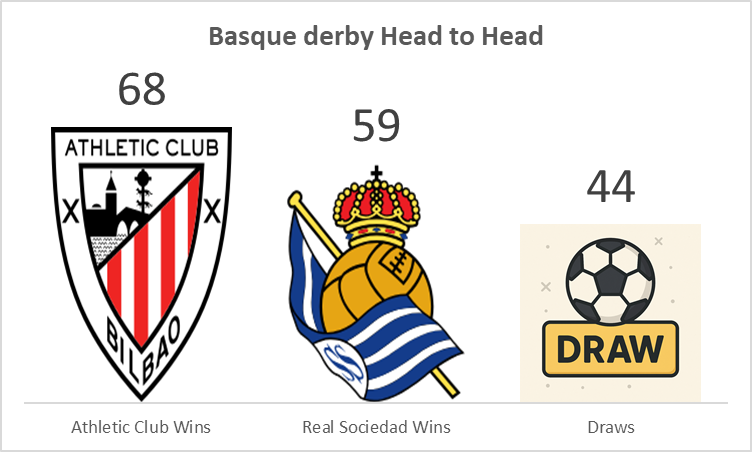
As of recent seasons, the overall record between Athletic Club and Real Sociedad across all major competitions (primarily La Liga and Copa del Rey) is remarkably balanced, reflecting the intense competition.
Key Records
- Most Goals in the Derby: Telmo Zarra (Athletic Club) is widely recognized as the top scorer in the history of the Basque derby football, with a significant number of goals against Real Sociedad.
- Most Appearances: José Ángel Iribar (Athletic Club) holds the record for most appearances for his club overall, and thus a very high number of derby appearances. For Real Sociedad, Luis Arconada similarly holds a high number of derby caps.
- Biggest Wins:
- Athletic’s Largest Win: Athletic Club 7-1 Real Sociedad (La Liga, 1930-31 season).
- Real Sociedad’s Largest Win: Real Sociedad 5-0 Athletic Club (La Liga, 1995-96 season).
Trophy Cabinet Comparison
Athletic Club historically has a more decorated trophy cabinet, particularly in the Copa del Rey, which they have won numerous times.
- Athletic Club:
- La Liga: 8 titles
- Copa del Rey: 24 titles (officially recognized; 23 by RFEF post-1903)
- Spanish Supercup: 3 titles
- Real Sociedad:
- La Liga: 2 titles
- Copa del Rey: 3 titles (including the 2020 edition against Athletic)
- Spanish Supercup: 1 title
While Athletic holds a numerical advantage in trophies, Real Sociedad’s recent Copa del Rey triumph against their rivals was a monumental achievement that significantly boosted their standing in the rivalry’s narrative.
The Modern Era: Current Dynamics and Recent Encounters
The Basque derby football continues to evolve, with both clubs adapting to the demands of modern football while staying true to their core identities. The modern era has seen shifts in power, tactical developments, and continued high stakes in every encounter.
Recent Form and League Positions
In recent seasons, Real Sociedad has often enjoyed a period of relative consistency, frequently challenging for European qualification and, at times, even the Champions League spots. Their tactical flexibility, combined with a strong homegrown core supplemented by smart international signings, has seen them play an attractive, possession-based style of football.
Athletic Club, constrained by its unique “Basque-only” policy, often faces a more challenging task in assembling a competitive squad. However, their unwavering commitment to the cantera has continued to produce exceptional talent. They remain a formidable force, particularly at home at San Mamés, and are perennial contenders in the Copa del Rey, a competition they recently won in 2024, ending a 40-year drought for a major trophy.
Key Modern Players
- Athletic Club: Iñaki Williams, Nico Williams, Oihan Sancet, and Unai Simón represent the blend of pace, power, creativity, and goalkeeping excellence that defines the current Athletic squad. Their attacking prowess, particularly on the wings, has been a significant threat in recent derbies.
- Real Sociedad: Mikel Oyarzabal, Martín Zubimendi, Takefusa Kubo, and Brais Méndez form the backbone of a technically gifted team. Oyarzabal’s leadership and goal-scoring, combined with Zubimendi’s midfield control and Kubo’s flair, make them a potent force.
Who Has the Upper Hand? (Recent Seasons)
While the overall head-to-head is close, Real Sociedad has arguably had the upper hand in La Liga encounters in the last few years leading up to the 2023-24 season. They have often finished higher in the league table and secured more consistent European berths. However, Athletic’s recent Copa del Rey triumph in 2024, which followed their win in the Spanish Supercup in 2021, demonstrates their continued ability to win silverware, often through direct elimination formats.
The 2020 Copa del Rey final victory for Real Sociedad was a massive psychological boost. However, Athletic’s subsequent Copa del Rey win in 2024 (though not against Real Sociedad) re-established their cup-winning pedigree and added another chapter to their storied history, ensuring the rivalry remains fiercely contested and unpredictable.
The Future of the Rivalry: Enduring Significance
The Basque derby football is not merely a relic of the past; it is a living, breathing entity that continues to shape the future of Spanish football. Its unique characteristics ensure its enduring significance for generations to come.
The “Cantera” Philosophy Endures
Both clubs remain deeply committed to their respective youth academies, Lezama (Athletic) and Zubieta (Real Sociedad). These academies are not just training grounds; they are cultural institutions that instill the values and identity of the club from a young age. The continuous production of homegrown talent ensures that future derbies will always feature players who truly understand the rivalry’s importance.
Athletic’s steadfast adherence to its unique policy guarantees that every player wearing the red and white stripes is a direct representation of Basque football. This policy, while challenging, ensures the club’s distinct identity in a globalized sport.
Financial Realities and European Ambitions
In an era dominated by financial disparities, both clubs operate with strong fiscal responsibility, relying heavily on their academies and smart recruitment. Their consistent pursuit of European football is crucial for financial stability and attracting top talent. Qualification for the Champions League or Europa League provides vital revenue and exposure, intensifying the battle for league positions.
The competition for European spots means that every derby match has significant implications beyond just local bragging rights, directly impacting their ambitions on the continental stage.
A Legacy of Passion and Respect
The future of the Basque derby football is secure because it is built on a foundation of deep-seated passion and mutual respect. It’s a rivalry that celebrates shared heritage while fiercely competing for supremacy. The traditions, the cultural ties, and the sheer love for football in the Basque Country ensure that this derby will continue to be one of the most compelling fixtures in the global football calendar.
New generations of fans will inherit the stories, the songs, and the fervent loyalty, ensuring that the flame of this unique rivalry burns brightly for decades to come.
Conclusion: The Enduring Heart of Basque Derby Football
The Basque derby football between Athletic Club Bilbao and Real Sociedad is a testament to the power of football as a cultural phenomenon. It is a rivalry forged in shared history, distinct philosophies, and an unwavering commitment to regional identity.
From the legendary clashes of the 1980s to Real Sociedad’s historic Copa del Rey triumph and Athletic’s recent cup glory, every chapter of this rivalry adds to its rich narrative. It’s a contest where statistics tell only part of the story, with passion, pride, and local loyalty forming the true essence of each encounter.
As the two clubs continue their pursuit of glory, the Basque derby will remain a highlight of the Spanish football calendar. It’s a vibrant, respectful, yet fiercely competitive battle that encapsulates the heart and soul of the Basque Country, reminding us all why football is truly “more than a game.” The enduring legacy of this rivalry is a beacon of regional pride and sporting excellence, captivating fans and celebrating a unique corner of the footballing world.

