
Football rivalries are the heartbeat of the beautiful game, transforming mere matches into epic sagas. Among Spain”s most passionate and deeply rooted contests is the “O Noso Derbi” – The Galician Derby – pitting Deportivo La Coruña against Celta Vigo. This isn”t just a game; it”s a clash of cities, cultures, and footballing philosophies, embodying the very soul of Galicia.
The Deportivo vs Celta rivalry transcends the ninety minutes on the pitch. It”s a narrative woven through decades of shared history, intense competition, and unforgettable moments. For fans of both clubs, this derby is the highlight of the season, a chance to assert regional dominance and earn bragging rights that last until the next encounter.
In this comprehensive analysis, we will delve into the rich tapestry of the Galician Derby, exploring its origins, cultural significance, legendary figures, and the statistical battles that define this iconic Spanish football rivalry.
Origins of the Rivalry
The roots of the Deportivo vs Celta rivalry are deeply embedded in the geography and social fabric of Galicia. A Coruña and Vigo, the region”s two largest cities, have long been economic and cultural rivals. A Coruña, in the north, historically served as the administrative capital, while Vigo, in the south, developed as a bustling industrial and fishing port.
The Birth of the Clubs
Deportivo La Coruña, founded in 1906, was one of Spain”s earliest football clubs. Real Club Celta de Vigo, however, has a slightly more complex origin. It was formed in 1923 through the merger of two existing Vigo-based clubs: Real Vigo Sporting and Real Fortuna Football Club. This consolidation was driven by a desire to create a stronger, unified club capable of competing with the best in Spain, including their nascent rivals in A Coruña.
The very act of Celta”s formation, designed to create a regional powerhouse, immediately set the stage for a competitive dynamic with Deportivo. Early matches were initially friendly contests, but the inherent urban and regional pride quickly fueled a more intense competition. As football grew in popularity across Spain, so did the fervor surrounding these Galician clashes.
Early Encounters and Regional Dominance
The first official match between the two clubs took place in 1928, marking the beginning of a long and storied rivalry. These early encounters were crucial for establishing regional supremacy, a title fiercely coveted by both sets of fans. Each victory was a declaration of the superior footballing identity of their respective city.
The rivalry intensified as both clubs gained prominence in Spanish football, frequently clashing in regional championships and later in the national league structure. From the outset, the derby was more than just a game; it was a battle for the soul of Galician football.
Cultural & Social Impact
The Galician Derby is a powerful expression of regional identity and pride. For many, supporting Deportivo or Celta is not merely a choice of football club, but an affirmation of their allegiance to either A Coruña or Vigo, and by extension, their particular interpretation of Galician identity.
A Tale of Two Cities
The cities themselves are distinct. A Coruña, often seen as more traditional and aristocratic, contrasts with Vigo”s industrial, working-class ethos. These perceived differences, whether real or imagined, are amplified in the context of the derby, creating a vibrant narrative that extends beyond football.
Families often find themselves divided, with siblings or parents supporting opposing teams. This friendly (and sometimes not-so-friendly) banter is a common feature of life in Galicia, particularly in the weeks leading up to the derby. It”s a rivalry that binds communities even as it divides households.
Fan Traditions and Atmosphere
Match days are an explosion of color, noise, and emotion. The Riazor (Deportivo”s stadium) and Balaídos (Celta”s stadium) become cauldrons of passion. Supporters, known as “Deportivistas” and “Celtistas,” create incredible atmospheres with elaborate tifos, banners, and chants.
- Ultras Groups: Both clubs boast passionate ultra groups – Riazor Blues for Deportivo and Celtarras for Celta – who drive the vocal support and choreographies.
- Pre-match Rituals: Pubs in both cities buzz with anticipation hours before kickoff, adorned in team colors. Convoys of cars and buses make the journey between A Coruña and Vigo, creating a festive, yet tense, atmosphere.
- Regional Pride: Chants often reference the “A Nosa Terra” (Our Land) concept, emphasizing the Galician identity that both clubs share, yet fiercely dispute ownership of in a footballing sense.
The intensity is palpable, with every tackle, pass, and shot met with thunderous roars or collective groans. The derby is a cultural event, a social gathering, and a powerful demonstration of loyalty that reverberates throughout the entire region.
Historic Matches & Moments
The Galician Derby has produced countless memorable encounters, often steeped in drama, controversy, and moments of pure footballing brilliance. These matches are etched into the folklore of both clubs.
The SuperDepor Era vs. Celta”s European Adventures
The late 1990s and early 2000s marked a golden age for both clubs, albeit with Deportivo reaching greater heights. Deportivo, known as “SuperDepor,” famously won La Liga in 2000, along with two Copa del Rey titles (1995, 2002). During this period, they often had the upper hand in the derby, but Celta always fought valiantly.
- 1999/2000 La Liga (Deportivo 1-0 Celta): A crucial victory for Deportivo en route to their historic league title. A single goal was enough to send Riazor into raptures.
- 2001/2002 Copa del Rey Semi-Final: Deportivo emerged victorious in a hard-fought two-legged affair, eventually going on to win the “Centenariazo” final against Real Madrid. This semi-final win against Celta was particularly sweet.
Celta, despite not winning major domestic titles during this era, consistently qualified for European competitions, including the UEFA Champions League, earning them the moniker “EuroCelta.” They often found ways to upset their more decorated rivals.
- 2002/2003 La Liga (Celta 3-0 Deportivo): A dominant Celta performance at Balaídos, showcasing their quality and proving they were more than capable of challenging the “SuperDepor.”
- 2003/2004 La Liga (Celta 0-5 Deportivo): A stunning and unforgettable result for Deportivo, delivering their biggest derby victory at Balaídos. Fran, Valerón, and Luque were instrumental in this rout. It was a day of absolute euphoria for Deportivistas.
Relegation Battles and Dramatic Returns
The derby has also seen its fair share of relegation-threatened clashes, where the stakes were astronomically high. Surviving at the expense of your rival adds an extra layer of triumph.
After periods of decline for both clubs, the 2011-2012 season saw them both in the Segunda División. The derbies that season were monumental, as both fought for promotion back to La Liga. Deportivo ultimately won the league, with Celta also achieving promotion on the final day, setting up a highly anticipated return to top-flight derbies.
The 2016-2017 season saw a memorable 0-1 victory for Celta at Riazor, courtesy of Iago Aspas. This was a significant win for Celta, breaking a long winless streak at their rival”s ground and further solidifying Aspas”s legendary status.
Legendary Players & Managers
The Galician Derby has been graced by numerous players and managers who have left an indelible mark on its history, becoming heroes or villains depending on which side of the divide you stand.
Deportivo Icons
- Fran González: A one-club man and true legend of Deportivo, Fran was the epitome of the “SuperDepor” era. His elegance, vision, and leadership were crucial. He scored several memorable derby goals and was a constant thorn in Celta”s side.
- Mauro Silva: The Brazilian defensive midfielder was the engine room of Deportivo. His calm presence and tactical intelligence were vital in many derby victories.
- Juan Carlos Valerón: The elegant playmaker, known for his exquisite passing and dribbling, often dictated the tempo of derby matches, creating magic moments.
- Djalminha: The fiery Brazilian attacking midfielder provided flair, controversy, and spectacular goals. His unpredictable genius often shone brightest in high-stakes games like the derby.
Celta Icons
- Aleksandr Mostovoi: “The Tsar” was the creative genius of Celta”s “EuroCelta” era. His skill, temperament, and ability to score crucial goals made him a fan favorite and a derby legend.
- Valeri Karpin: The Russian winger formed a formidable partnership with Mostovoi, known for his powerful runs and thunderous shots. He was a constant threat in the derby.
- Iago Aspas: Undoubtedly Celta”s modern-day icon. Aspas, a local boy, embodies the spirit of Celta. His prolific goal-scoring, passion, and ability to deliver in big games have made him a derby hero, particularly for his goals against Deportivo.
- Michel Salgado: While he achieved greater fame at Real Madrid, Salgado started his career at Celta and played in several derbies, showcasing his tenacious defending.
Managers Who Shaped the Derby
Coaches like Javier Irureta for Deportivo and Víctor Fernández for Celta significantly influenced their respective teams” approaches to the derby, often engaging in tactical battles that added another layer of intrigue to the encounters. Their strategies often determined the outcome, making them central figures in the rivalry”s narrative.
Statistics & Records
The Deportivo vs Celta rivalry is rich in statistics, offering a clear picture of the historical balance of power. While exact numbers can vary slightly depending on the inclusion of minor competitions, the overall trend remains consistent.
Head-to-Head Record (Official Matches – All Competitions)
Based on widely accepted records for official matches (La Liga, Copa del Rey, Segunda División):
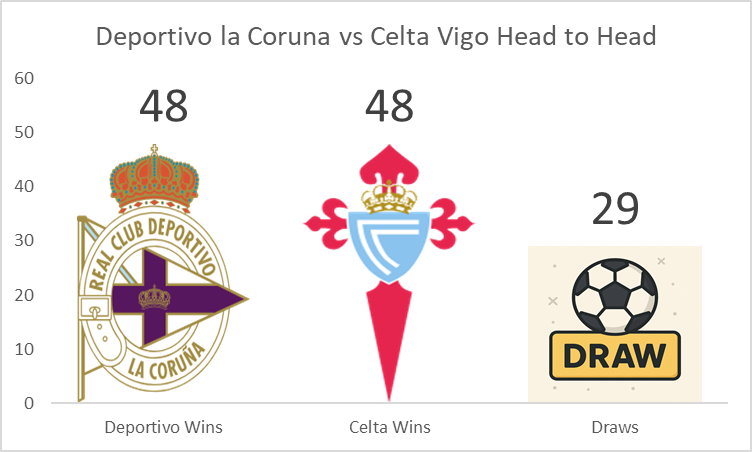
Historically, Deportivo has held a slight edge in the overall head-to-head record, especially due to their dominant “SuperDepor” era. However, Celta has closed the gap significantly in more recent times.
Key Statistical Highlights
- Biggest Deportivo Win: Celta 0-5 Deportivo (La Liga, 2003/2004 season).
- Biggest Celta Win: Celta 6-1 Deportivo (La Liga, 1947/1948 season).
- Highest Scoring Derby: Celta 6-1 Deportivo (La Liga, 1947/1948 season) and Celta 5-2 Deportivo (La Liga, 1957/1958 season).
Trophies & Achievements
A comparison of major domestic trophies further highlights the rivalry”s context:
Deportivo La Coruña:
- La Liga: 1 (1999/2000)
- Copa del Rey: 2 (1994/1995, 2001/2002)
- Spanish Super cup: 3 (1995, 2000, 2002)
Celta Vigo:
- No major domestic trophies.
- Copa del Rey Runner-up: 3 times (1948, 1994, 2001)
While Celta has a rich history and numerous strong finishes, Deportivo”s single La Liga title and multiple Copa del Rey wins give them a significant advantage in terms of major silverware, a point of pride for Deportivistas and often a sore point for Celtistas.
Top Derby Goal Scorers (Approximate)
- Deportivo: Fran, Bebeto, Roy Makaay, Diego Tristán.
- Celta: Iago Aspas, Hermidita, Pahiño, Mostovoi.
Iago Aspas has emerged as Celta”s modern derby specialist, scoring crucial goals that have cemented his place in the club”s history.
The Modern Era
The landscape of the Deportivo vs Celta rivalry has shifted considerably in recent years, primarily due to the differing fortunes of the two clubs. While Celta Vigo has maintained its presence in La Liga for over a decade, Deportivo La Coruña has experienced a painful decline, falling through the divisions.
Divergent Paths
Deportivo”s relegation from La Liga in 2018 marked the beginning of a challenging period. Subsequent relegations saw them drop to the third tier of Spanish football (Primera Federación), a stark contrast to their “SuperDepor” glory days. This has meant that top-flight derbies have become a rarity.
Celta, meanwhile, has solidified its position in La Liga, often battling in the mid-table, occasionally pushing for European spots, and consistently relying on the brilliance of players like Iago Aspas. Their stability in the top division has given them the upper hand in the modern narrative of Galician football.
Recent Encounters
The last competitive derbies in La Liga took place during the 2017-2018 season:
- 23 December 2017: Deportivo 1-3 Celta (at Riazor). Goals from Daniel Wass and Iago Aspas (2) secured a comfortable win for Celta, with Andone scoring for Deportivo.
- 5 May 2018: Celta 1-1 Deportivo (at Balaídos). Maxi Gómez scored for Celta, and Lucas Pérez equalized for Deportivo. This draw contributed to Deportivo”s eventual relegation.
These results reflect Celta”s stronger position at the time, with Iago Aspas often being the difference-maker. The absence of top-flight derbies since then has left a void for fans of both clubs.
The Copa del Rey as a Potential Meeting Ground
With Deportivo in a lower division, the Copa del Rey remains the most likely stage for the Deportivo vs Celta rivalry to be rekindled. A cup draw between the two would undoubtedly ignite the passion and nostalgia of the derby, regardless of their league standings.
The rivalry, although less frequent in recent times, remains potent. Fans of both sides eagerly await the day their paths cross again, recognizing that the derby is essential for the vibrancy of Galician football.
The Future of the Rivalry
The current state of the Deportivo vs Celta rivalry is one of anticipation. While Celta Vigo continues to compete in La Liga, Deportivo La Coruña is fiercely battling to climb back up the Spanish football pyramid. Their presence in the Primera Federación (third tier) means a return to the top flight is a multi-season project.
The Path to Revival
Deportivo”s immediate goal is promotion to the Segunda División, followed by a sustained effort to return to La Liga. The club and its passionate fanbase are committed to this journey, understanding that a strong Deportivo is vital for the full resurgence of the Galician Derby.
A return to La Liga for Deportivo would not only reignite one of Spain”s most historic rivalries but also bring immense financial and sporting benefits to both clubs and the entire region. The anticipation for this reunion is a powerful driving force for Deportivistas.
Enduring Significance
Even with the current league disparity, the cultural and social significance of the rivalry remains undiminished. The memories of past derbies, the stories of legendary players, and the inherent “us vs. them” mentality ensure that the flame of the Deportivo vs Celta rivalry continues to burn brightly.
Younger generations of fans, while perhaps not having witnessed as many top-flight derbies, are indoctrinated into the rivalry through family allegiances and club history. The derby is a fundamental part of their footballing identity.
A Call for its Return
The footballing world, particularly in Spain, yearns for the return of the Galician Derby to its rightful place among the country”s elite fixtures. The intensity, the passion, and the unique Galician flavor it brings are sorely missed. The next chapter of this rivalry promises to be as compelling as its storied past, whenever the two giants of Galician football meet again on the grandest stage.
Conclusion
The Deportivo vs Celta rivalry is far more than just a series of football matches; it is a profound cultural phenomenon that encapsulates the spirit of Galicia. From its historical origins rooted in urban competition to its modern-day yearning for a return to the top flight, “O Noso Derbi” has consistently delivered drama, passion, and unforgettable moments.
We have explored the deep social impact, the legendary figures who defined its golden eras, and the statistical battles that paint a picture of its competitive nature. While recent years have seen the clubs take divergent paths, the intensity of feeling among fans remains as strong as ever, a testament to the rivalry”s enduring power.
The Galician Derby serves as a vibrant reminder of how football can intertwine with identity, history, and community. As Deportivo La Coruña strives to rejoin Celta Vigo in La Liga, the anticipation for the next top-flight encounter continues to build. When that day comes, the Riazor and Balaídos will once again erupt, celebrating not just a game, but the soul of Galician football.
The story of the Deportivo vs Celta rivalry is a testament to the beautiful, often fierce, loyalty that defines the sport. It”s a rivalry that will continue to captivate, inspire, and define football in Galicia for generations to come.

