
In the vibrant tapestry of German football, few threads are woven with as much passion, history, and animosity as the Nordderby. This epic clash between Hamburger SV (HSV) and SV Werder Bremen is not merely a fixture on the calendar; it is a cultural phenomenon, a battle for regional supremacy that has captivated fans for over a century. Known as Germany’s oldest and perhaps most intense derby, the Nordderby rivalry transcends mere sport, embodying the pride and identity of two great northern cities.
For generations, the supporters of these two clubs have lived and breathed this contest. It is a rivalry forged in geographical proximity, sporting ambition, and a deep-seated desire to outperform the other. Every encounter, whether in the top flight or a cup competition, carries the weight of history and the promise of unforgettable drama. Join us as we delve into the heart of this iconic German football rivalry, examining its origins, its greatest moments, and its enduring legacy.
Origins of the Nordderby Rivalry
The roots of the Nordderby stretch back to the early 20th century, long before the advent of the Bundesliga. Both Hamburg and Bremen are significant port cities in Northern Germany, situated approximately 100 kilometers apart. This geographical closeness naturally fostered a competitive spirit, initially in trade and then fiercely in sport.
The first recorded meeting between the two clubs took place on 14th September 1921. Even then, an air of regional pride permeated the contest. As football grew in popularity across Germany, the matches between HSV and Werder Bremen quickly became highlights of the season in the northern leagues.
A pivotal moment in solidifying the rivalry’s status came with the formation of the Bundesliga in 1963. Both Hamburger SV and SV Werder Bremen were founding members of Germany’s new professional league. This meant regular, high-stakes encounters on a national stage, elevating the derby’s profile and intensifying the competition.
In the early Bundesliga years, HSV often held the upper hand, establishing themselves as a dominant force. Werder Bremen, however, soon rose to challenge this supremacy, ensuring that the battles for league position and bragging rights were consistently fierce. This initial period laid the groundwork for the deep-seated rivalry that would define German football for decades.
Cultural & Social Impact
The Nordderby is far more than just a football match; it is a significant cultural event that permeates the social fabric of Hamburg and Bremen. The rivalry is deeply ingrained in the local identity of both cities, impacting everything from daily conversations to public mood.
For weeks leading up to a derby, the cities buzz with anticipation. Local media dedicates extensive coverage, dissecting every angle, statistic, and player quote. It is a topic of discussion in workplaces, schools, and family gatherings, often creating friendly (and sometimes not-so-friendly) divisions.
Fan Traditions & Atmosphere
The supporters of HSV and Werder Bremen are renowned for their passion and loyalty. Match days are characterized by vibrant displays, elaborate choreographies, and a cacophony of chants that echo through the stadiums. The Volksparkstadion in Hamburg and the Weserstadion in Bremen transform into cauldrons of emotion, each set of fans determined to outsing and outwit the other.
- Tifos & Banners: Elaborate visual displays, often poking fun at the opposition or celebrating their own club’s history, are common.
- Merchandise: Local shops are awash with club colours, and fans proudly wear their jerseys, scarves, and hats, especially in the derby week.
The outcome of a Nordderby can significantly influence the mood of an entire city for days, if not weeks. A victory brings jubilation and bragging rights, while a defeat can cast a pall over the losing city. This intense emotional investment highlights the profound cultural and social impact of this enduring rivalry.
Historic Matches & Moments
Over the decades, the Nordderby has produced countless memorable encounters, defining moments, and dramatic narratives. These matches are etched into the folklore of both clubs, recounted by generations of fans.
Early Bundesliga Thrillers
One of the earliest iconic moments came in the 1964/65 season. HSV, then a dominant force, hosted Werder Bremen and suffered a surprising 4-2 defeat. This result was a statement from Werder, signalling their intent to challenge Hamburg’s northern supremacy, a challenge they eventually backed up by winning the Bundesliga title that season.
Another classic from the early era was HSV’s emphatic 5-0 victory over Werder in 1964. Such dominant performances were not uncommon in the fledgling Bundesliga, but they always left a lasting mark on the rivalry’s narrative.
The “Four Derbies in 19 Days” (2009)
Perhaps the most extraordinary period in the Nordderby’s history occurred in April and May 2009. Within just 19 days, HSV and Werder Bremen faced each other an astonishing four times in three different competitions, creating an unprecedented level of tension and drama.
- Bundesliga (26th April): The first encounter was a league match, ending in a 2-0 victory for Werder Bremen.
- DFB-Pokal Semi-Final (22nd April): Just four days later, they met in the DFB-Pokal semi-final. A thrilling 1-1 draw led to a penalty shootout, which Werder Bremen famously won 4-2, progressing to the final.
- UEFA Cup Semi-Final First Leg (30th April): The European encounter saw HSV win the first leg at home 1-0, giving them a slender advantage.
- UEFA Cup Semi-Final Second Leg (7th May): The decisive second leg in Bremen was a rollercoaster. Werder Bremen secured a 3-2 victory, progressing to the final on away goals after a 3-3 aggregate score. This match is particularly remembered for a bizarre moment where a paper ball contributed to a goal for Werder, causing controversy.
Werder Bremen emerged as the clear victors of this intense period, winning the DFB-Pokal and reaching the UEFA Cup final. This sequence of matches cemented the 2008/09 season as one of the most iconic chapters in the Nordderby saga, leaving HSV fans heartbroken and Werder supporters ecstatic.
Other Notable Matches
- 2004 Bundesliga: Werder Bremen achieved their largest Nordderby victory, a resounding 6-0 win over HSV.
- 2015 Bundesliga: A crucial relegation battle where Werder Bremen secured a 1-0 victory, effectively condemning HSV to another season fighting relegation.
- 2018 Bundesliga: The last Bundesliga Nordderby before HSV’s relegation, ending in a 1-0 draw, a somewhat anticlimactic end to an era of top-flight derbies.
These historic clashes, often filled with goals, controversial decisions, and raw emotion, underscore why the Nordderby holds such a special place in German football history. They are the stories passed down, fueling the rivalry’s fire for new generations of fans.
Legendary Players & Managers
No rivalry is complete without the heroes and villains who define its narrative. The Nordderby has been graced by some of German and international football’s greatest talents, whose performances in these high-stakes matches have become legendary.
Hamburger SV Icons
- Uwe Seeler: “Uns Uwe” is arguably the greatest HSV player of all time. A prolific striker and a one-club man, Seeler embodied the spirit of Hamburg. His leadership and goal-scoring prowess were central to HSV’s early success, and his commitment to the club made him a lasting symbol of the Nordderby.
- Kevin Keegan: The English superstar graced the Volksparkstadion in the late 1970s, winning two Ballon d’Or awards during his time at HSV. His charisma and skill elevated HSV to European prominence, making him a formidable presence in derby clashes.
- Manfred Kaltz: Known for his “banana kicks” (curling crosses), Kaltz was a defensive stalwart and an attacking threat from right-back. He holds the record for most Bundesliga appearances for HSV and was a key figure in their golden era, participating in numerous Nordderbies.
- Felix Magath: A powerful midfielder and later a successful manager, Magath scored the winning goal in the 1983 European Cup final for HSV. His tenacity and determination were often on full display in the emotionally charged derby matches.
- Rafael van der Vaart: In more recent times, the Dutch playmaker provided moments of brilliance and leadership for HSV, often being the creative spark against Werder.
SV Werder Bremen Legends
- Rudi Völler: Before becoming a World Cup winner, Völler was a prolific striker for Werder Bremen in the 1980s. His goals and dynamic play made him a constant threat in the Nordderby.
- Marco Bode: A true one-club man, Bode spent his entire professional career at Werder Bremen. A versatile attacker, he was a key figure in Werder’s successful teams of the 1990s and early 2000s, known for his intelligence and loyalty.
- Ailton: The Brazilian striker was an explosive force for Werder Bremen, famously becoming the first foreign player to win the Bundesliga top scorer award in 2004, the year Werder won the double. His raw power and goal-scoring instincts made him a Nordderby menace.
- Torsten Frings: A combative and influential midfielder, Frings was a leader on the pitch. His passion and commitment, especially in big games like the Nordderby, endeared him to the Werder faithful.
- Diego: The Brazilian playmaker brought flair and creativity to Werder Bremen in the late 2000s. His ability to score spectacular goals and dictate play made him a standout performer, especially during the “four derbies in 19 days” period.
- Claudio Pizarro: A legendary striker known for his longevity and goal-scoring prowess, Pizarro had multiple stints at Werder Bremen. His experience and clinical finishing made him a constant threat, and he scored many important goals against HSV.
Influential Managers
- Ernst Happel (HSV): The Austrian tactical genius led HSV to the European Cup in 1983 and two Bundesliga titles. His disciplined yet attacking style brought unprecedented success, including dominance in the Nordderby during his tenure.
- Otto Rehhagel (Werder Bremen): “King Otto” transformed Werder Bremen into a consistent Bundesliga power in the 1980s and 90s, winning two Bundesliga titles and two DFB-Pokals. His pragmatic yet effective approach often saw his Werder teams get the better of HSV.
These individuals, through their skill, passion, and indelible moments, have woven themselves into the fabric of the Nordderby, becoming symbols of their respective clubs and the rivalry itself.
Statistics & Records
The numbers behind the Nordderby tell a story of fierce competition, fluctuating fortunes, and remarkably balanced rivalry. While exact figures can vary slightly depending on the source’s definition of “competitive matches,” the overall picture remains clear.
Overall Head-to-Head Record (Competitive Matches)
As of the most recent competitive encounters, the statistics are incredibly close, reflecting the enduring nature of the rivalry. Across all competitions (Bundesliga, DFB-Pokal, UEFA Cup/Europa League):
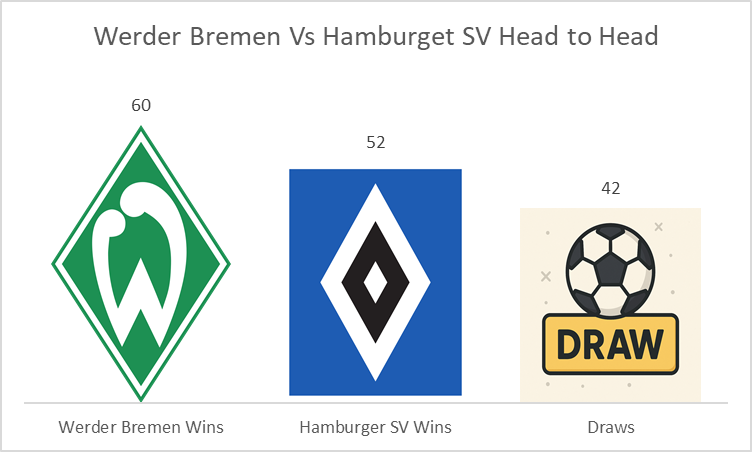
This slight edge for Werder Bremen in overall wins underscores their consistent performance, especially in crucial cup ties. However, the relatively high number of draws also highlights the tight, often cagey nature of these encounters.
Bundesliga Head-to-Head
The majority of the competitive matches have occurred in the Bundesliga:
- Total Bundesliga Matches: 108.
- Werder Bremen Wins: 39.
- Hamburger SV Wins: 34.
- Draws: 35.
Again, Werder holds a marginal lead, but the statistics demonstrate a truly balanced contest over the long run of Germany’s top flight.
Major Trophy Haul
Both clubs boast impressive trophy cabinets, adding to the prestige and stakes of their rivalry.
| Club | Bundesliga | DFB-Pokal | European Cup / Champions League | Cup Winners’ Cup |
|---|---|---|---|---|
| Hamburger SV | 6 | 3 | 1 (1983) | 1 (1977) |
| Werder Bremen | 4 | 6 | 0 | 1 (1992) |
HSV has a historical advantage in Bundesliga titles and the prestigious European Cup, while Werder Bremen boasts more DFB-Pokal triumphs. Both have a Cup Winners’ Cup to their name, demonstrating their pedigree on the European stage.
Notable Records
- Biggest Nordderby Wins:
- HSV 5-0 Werder Bremen (1964)
- Werder Bremen 6-0 HSV (2004)
- Most Appearances: Manfred Kaltz (HSV) and Marco Bode (Werder Bremen) are among the players with the most Nordderby appearances, symbolizing their long-standing commitment to their respective clubs.
- Top Scorers: While precise Nordderby-specific top scorer lists are hard to consolidate across all competitions and eras, players like Uwe Seeler,
Willi Schröder, Horst Hrubesch, and Arnold Schütz have undoubtedly scored some of the most crucial goals in this fixture’s history. Uwe Seeler is the leading scorer of this fixture.
These statistics provide a quantitative measure of the Nordderby’s intensity and balance. They show that success has ebbed and flowed, but neither team has ever truly dominated the other for an extended period, keeping the rivalry vibrant and unpredictable.
The Modern Era of the Nordderby
The landscape of the Nordderby has undergone significant changes in recent years, primarily due to Hamburger SV’s relegation from the Bundesliga in 2018. This event marked the end of an era, as HSV lost its “dinosaur” status as the only original Bundesliga club never to be relegated.
Since 2018, regular Bundesliga Nordderbies have been absent, leaving a void for fans of both clubs and German football enthusiasts alike. The direct clashes have become rarer, confined mostly to DFB-Pokal encounters.
Recent Encounters
Despite the league separation, the rivalry remains potent. When the teams do meet in cup competitions, the intensity is as high as ever. The last notable competitive match was in the Bundesliga.
- 2. Bundesliga 2021/22, (27th February 2020): Werder Bremen defeated HSV 3-2 in a thrilling cup tie at the Volksparkstadion. This result, once again, saw Werder emerge victorious in a high-stakes match, much to the dismay of the home fans.
This match served as a stark reminder of the enduring passion and competitive edge that defines the Nordderby, even when the teams are in different leagues. HSV has been consistently pushing for promotion from the 2. Bundesliga, narrowly missing out multiple times, while Werder Bremen themselves faced relegation to the 2. Bundesliga in 2021 before making an immediate return in 2022. For the season, 2024/2025 HSV were promoted to the Bundesliga implying that in the current season the rivalry will be renewed in the Bundesliga.
During the period leading up to HSV’s relegation, Werder Bremen often had the upper hand in league encounters. From the 2008/09 season (the “four derbies” year) until HSV’s drop, Werder generally achieved more favorable results, including crucial wins that contributed to HSV’s struggles.
The absence of regular derbies in the Bundesliga has highlighted how much these fixtures were taken for granted. The longing for their return is palpable among fans, demonstrating the Nordderby’s continued relevance and importance in German football culture.
The Future of the Nordderby Rivalry
The future of the Nordderby is intrinsically linked to the fortunes of both clubs. For the rivalry to truly reignite in its historical intensity, a return to regular Bundesliga fixtures is essential. This prospect largely depends on Hamburger SV’s ability to achieve promotion back to the top flight.
HSV has been a consistent challenger in the 2. Bundesliga, often finishing in the promotion playoff spots or just outside them. Their return would not only restore one of German football’s biggest clubs to its rightful place but also bring back one of its most cherished rivalries.
Enduring Significance
Even without annual league encounters, the Nordderby rivalry remains a powerful force. It is kept alive through:
- Fan Memory: Generations of fans remember the glory and heartbreak of past derbies.
- Media Coverage: Any potential cup draw between the two clubs immediately generates immense media attention.
- Youth & Reserve Teams: The rivalry continues at lower levels, nurturing the competitive spirit among younger players and fans.
- Social Media: Online platforms provide a constant forum for fans to engage in banter and uphold the rivalry.
The enduring appeal of the Nordderby lies in its tradition, its cultural resonance, and the deep-seated passion it evokes. Its future, while currently in a period of transition, promises to be as captivating as its past, waiting for the moment when these two giants of Northern German football regularly lock horns once more.
Conclusion
The Nordderby between Hamburger SV and SV Werder Bremen stands as a testament to the power and passion of football rivalries. From its early origins rooted in geographical proximity and regional pride to its storied history filled with iconic matches and legendary figures, this contest has shaped German football for over a century.
It is a rivalry that transcends the 90 minutes on the pitch, deeply impacting the cultural and social fabric of two proud cities. The chants, the tifos, the debates, and the shared memories all contribute to a collective identity for fans of both clubs. While the modern era has seen a temporary hiatus from regular top-flight derbies, the fire of the Nordderby continues to burn brightly, fueled by history and the anticipation of its full return.
The statistics, though showing a slight edge for Werder Bremen, ultimately underscore the remarkable balance and competitive nature of this rivalry. The future holds the promise of renewed Bundesliga clashes, which would undoubtedly inject fresh energy into German football. The Nordderby is more than just a game; it is a vital part of Germany’s sporting heritage, an enduring symbol of regional pride, and a powerful reminder of why we love football.

