
Football, at its heart, is about passion. It”s about the roar of the crowd, the agony of defeat, and the ecstasy of victory. But nowhere is this passion more intensely distilled than in a local derby. Among Europe”s most fervent, the Seville derby rivalry stands out, a vibrant explosion of emotion that transcends sport.
Known as “El Gran Derbi,” the clash between Real Betis Balompié and Sevilla Fútbol Club is more than just 90 minutes of football. It”s a battle for the soul of a city, a contest of identity, pride, and bragging rights that divides families and friends across Seville.
This long-form analysis delves into the heart of this iconic Andalusian confrontation. We will explore its deep historical roots, its profound cultural significance, the legendary figures who have graced its stage, and the enduring statistics that tell the story of a rivalry unlike any other.
Origins of the Rivalry: A City Divided
The roots of the Seville derby rivalry are deeply intertwined with the social fabric of Seville itself. It began not just with two football clubs, but with differing ideologies and social classes.
The Birth of Two Titans
Sevilla Fútbol Club, founded in 1905, was initially seen as the club of the city”s bourgeoisie, the more established and affluent segment of society. Their early success reflected this foundation, quickly becoming a dominant force in regional football.
Real Betis Balompié, established in 1907 (though its origins trace back to a split from Sevilla FC in 1907, formally becoming Real Betis Balompié in 1914 after merging with another club and receiving royal patronage), emerged from a different background. It quickly became the standard-bearer for the working class, the “people”s club,” embodying a resilient, underdog spirit.
The Fateful Split and Early Clashes
The initial schism that paved the way for Betis”s creation involved a dispute over the eligibility of a working-class player. This event solidified the contrasting identities that would define the rivalry for generations.
The first official derby match took place on October 8, 1915, in the Copa del Rey. Sevilla emerged victorious with a resounding 4-3 win, setting an early tone for the competitive nature of this budding rivalry. From these early encounters, the stage was set for a passionate, often fiery, contest for supremacy.
Cultural & Social Impact: More Than Just a Game
The Seville derby rivalry permeates every aspect of life in the Andalusian capital. It”s not merely a sporting event; it”s a cultural phenomenon that defines identities, ignites conversations, and paints the city in its rival colours.
A City of Two Halves
Seville is famously divided by its football allegiances. Families often find themselves split, with some members staunch “Sevillistas” (Sevilla fans) and others devoted “Béticos” (Betis fans). This friendly (and sometimes not-so-friendly) banter is a constant presence in homes, workplaces, and social gatherings.
The green and white of Betis and the red and white of Sevilla are not just club colours; they are symbols of belonging. Neighbourhoods often lean one way or the other, creating distinct pockets of loyal support throughout the city.
Fan Traditions and Atmosphere
Match days are an explosion of sound and colour. The build-up is palpable, with fans gathering hours before kick-off, singing traditional chants and displaying elaborate tifos.
- Pre-match rituals: Both sets of fans have unique ways of preparing for the derby, from specific meeting points to traditional songs.
- Tifos and banners: Intricate displays covering entire stands are common, often carrying messages of pride or playful jabs at the opposition.
- Passionate chants: The songs are unique to each club, reflecting their history, values, and often, their disdain for the rival. The atmosphere inside the Ramón Sánchez Pizjuán (Sevilla”s home) and the Estadio Benito Villamarín (Betis”s home) is arguably one of the most intense in world football.
The derby is a spectacle that transcends the pitch, drawing global attention to Seville”s unique and fervent football culture. It”s a testament to how deeply football is woven into the identity of the city”s inhabitants.
Historic Matches & Moments: Defining “El Gran Derbi”
Over more than a century, the Seville derby rivalry has produced countless unforgettable encounters. These matches are etched into the folklore of both clubs, defining eras and shaping narratives.
Early Triumphs and Shifting Dominance
- Betis”s La Liga Title (1934-35): A monumental achievement, Betis claimed their only La Liga title under coach Patrick O”Connell, beating Real Madrid and other giants. This era saw Betis briefly eclipse their rivals, a source of immense pride for Béticos.
- Sevilla”s La Liga Title (1945-46): Sevilla responded a decade later, securing their sole La Liga championship. This period solidified their status as a major force in Spanish football, adding another layer to the rivalry”s competitive edge.
High-Stakes Encounters
Many derbies have carried immense stakes beyond mere bragging rights. Promotions, relegations, and European qualification have often been decided by these clashes.
- The “Derby of the Century” (1980): A highly anticipated match where both teams were fighting for European places. Sevilla won 2-1, a result that had significant implications for the league table and cemented its place in derby lore.
- Copa del Rey Quarter-Final (2007): This tie was particularly infamous. A bottle thrown from the stands hit Sevilla coach Juande Ramos, leading to the match being suspended and later completed behind closed doors in Getafe. Sevilla ultimately progressed, but the incident highlighted the extreme tension surrounding the fixture.
Modern Classics and Goal-Fests
The 21st century has delivered its share of thrilling derbies, showcasing attacking football and dramatic comebacks.
- Sevilla 5-1 Real Betis (2012): A dominant display by Sevilla, with José Antonio Reyes scoring twice, inflicting a heavy defeat on their rivals and providing immense joy for the Sevillista faithful.
- Real Betis 5-3 Sevilla (2018): A chaotic, high-scoring affair at the Benito Villamarín. Betis secured a memorable victory in a match that saw eight goals, demonstrating their attacking prowess and providing a modern classic for Béticos.
- Sevilla 3-2 Real Betis (2019): Another five-goal thriller, this time going Sevilla”s way. Luuk de Jong”s late winner sealed a dramatic victory, showcasing the fine margins that often decide these contests.
These matches are not just results; they are stories told and retold, shaping the narrative of the Seville derby rivalry for generations of fans.
Legendary Players & Managers: Faces of the Rivalry
Certain individuals have left an indelible mark on the Seville derby rivalry, their names synonymous with the passion and intensity of these encounters. They are the heroes, the villains, and the symbols of their respective clubs.
Real Betis Icons
- Rafael Gordillo: A true Bético legend, Gordillo was an attacking left-back known for his powerful runs and dedication. He played over 300 games for Betis across two spells and is revered for his unwavering loyalty.
- Joaquín Sánchez: The ultimate modern Betis icon. A winger with incredible longevity and flair, Joaquín embodied the Betis spirit with his charisma, skill, and deep love for the club. His multiple spells and record-breaking appearances make him a living legend.
- Alfonso Pérez: An elegant striker who came through Betis”s youth ranks. His goal-scoring prowess and connection with the fans made him a beloved figure during his time at the club.
Sevilla FC Legends
- Juan Arza: “El Niño de Oro” (The Golden Boy) is Sevilla”s all-time leading scorer in La Liga. A prolific forward, Arza was the face of Sevilla”s golden era in the 1940s and 50s and a constant threat in derbies.
- José Antonio Reyes: An academy product who burst onto the scene with his dazzling skill. Reyes represented the pride of Seville and, despite also playing for Arsenal and Real Madrid, remained a cherished figure for Sevilla, scoring crucial derby goals. His tragic passing further cemented his legendary status.
- Frédéric Kanouté: The Malian striker was a pivotal figure in Sevilla”s trophy-laden era of the 2000s. His composure, goal-scoring ability, and leadership were instrumental in many derby victories.
- Jesús Navas: Another local hero and academy product, Navas”s speed and crossing ability have made him a constant threat. His incredible longevity and dedication to Sevilla make him a modern-day icon, having played in countless derbies.
Managers Who Shaped the Derby
Managers also play a crucial role in the derby”s narrative, their tactical decisions and pre-match rhetoric often adding fuel to the fire.
- Juande Ramos (Sevilla): His tenure saw Sevilla achieve unprecedented European success, often at Betis”s expense, making him a figure of both adoration and intense rivalry.
- Manuel Pellegrini (Real Betis): The “Engineer” brought stability and a distinct playing style to Betis, leading them to Copa del Rey glory and consistent European qualification, directly challenging Sevilla”s recent dominance.
These individuals, through their talent and commitment, have woven themselves into the tapestry of the Seville derby rivalry, ensuring their legacies endure long after their playing or coaching days.
Statistics & Records: The Numbers Behind the Passion
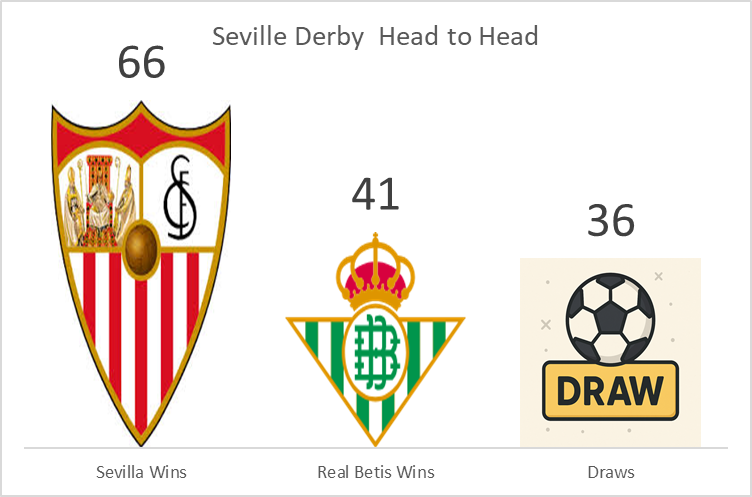
While passion fuels the Seville derby rivalry, statistics provide a factual backbone, illustrating periods of dominance and the overall balance of power. These numbers are often cited, debated, and used as ammunition by fans.
Head-to-Head Record across all official competitions :
Trophy Cabinet Comparison (Major Titles)
When it comes to major silverware, Sevilla has enjoyed a more successful period in the 21st century, particularly on the European stage.
- Sevilla FC:
- La Liga: 1 (1945-46)
- Copa del Rey: 5 (1935, 1939, 1948, 2007, 2010)
- UEFA Europa League/UEFA Cup: 7 (2006, 2007, 2014, 2015, 2016, 2020, 2023) – A record.
- UEFA Super Cup: 1 (2006)
- Real Betis Balompié:
- La Liga: 1 (1934-35)
- Copa del Rey: 3 (1977, 2005, 2022)
Sevilla”s remarkable dominance in the Europa League has given them a significant advantage in total trophy count, a fact often highlighted by Sevillistas.
Individual Records
- Top Scorers in the Derby: While exact figures can be debated for older eras, players like Juan Arza (Sevilla) and Poli (Betis) are often cited for their prolificacy. In the modern era, Frédéric Kanouté and José Antonio Reyes for Sevilla, and Joaquín for Betis, have all made significant goal contributions.
- Most Appearances: Joaquín Sánchez holds the record for most appearances for Real Betis in the derby, showcasing his incredible longevity. For Sevilla, Jesús Navas holds a similar distinction, reflecting his enduring presence.
Statistical analysis reveals that while Betis has periods of strong performance and iconic victories, Sevilla has generally maintained a higher level of consistency and accumulated more silverware, especially in recent decades. This statistical disparity often fuels the narrative of the underdog for Betis, adding another layer to the rivalry”s charm.
The Modern Era: Current Dynamics & Recent Encounters
The Seville derby rivalry continues to evolve, with new tactical approaches, global influences, and the ever-present drama of La Liga football. The modern era has seen both clubs strive for European qualification, intensifying the stakes of every derby.
Recent Form and European Ambitions
In the 21st century, Sevilla FC established itself as a consistent force in Spanish and European football, particularly in the UEFA Europa League, where they have achieved unprecedented success. This period saw them regularly finish higher in La Liga than their rivals and secure more major trophies.
Real Betis, after periods of instability, has enjoyed a resurgence in recent years. Under coaches like Manuel Pellegrini, they have consistently challenged for European places, won the Copa del Rey in 2022, and adopted an attractive, attacking style of play that has resonated with their fanbase.
Recent Derby Encounters (Last 5-7 Matches, Example Results)
The recent derbies have been tightly contested, reflecting the improved standing of Real Betis:
- May 2023: Sevilla 0-0 Real Betis: A tense draw, showcasing defensive solidity from both sides.
- November 2022: Real Betis 1-1 Sevilla: Another draw, with both teams sharing the spoils in a hard-fought battle.
- March 2022: Real Betis 0-0 Sevilla (Copa del Rey): This match was abandoned after a Betis fan threw a pole at Sevilla player Joan Jordan. The remaining minutes were played behind closed doors, with Betis eventually winning 2-1.
- February 2022: Sevilla 2-1 Real Betis: Sevilla edged out Betis in a crucial league encounter.
- January 2021: Real Betis 1-1 Sevilla: A classic derby draw, with both teams fighting hard for points.
- June 2020: Sevilla 2-0 Real Betis: The first match back after the COVID-19 lockdown, played without fans, still saw Sevilla claim victory.
These results indicate a trend towards closer matches, often with fewer goals, as both teams have become more tactically astute and defensively organised. The intensity, however, remains undiminished.
Tactical Battlegrounds
Modern derbies are often tactical chess matches. Managers analyze every detail, looking for weaknesses. The focus is often on:
- Midfield dominance: Controlling the tempo and possession.
- Wing play: Exploiting wide areas for crosses and penetration.
- Set pieces: Often a decisive factor in tight games.
The global reach of La Liga ensures that the Seville derby rivalry is now watched by millions worldwide, amplifying its profile and impact. The stakes are higher than ever, not just for local pride, but for European football”s competitive landscape.
The Future of the Rivalry: Enduring Passion
As football continues to evolve, so too will the Seville derby rivalry. Yet, one thing remains certain: its enduring passion will continue to captivate fans for generations to come. The essence of this rivalry is too deeply ingrained in the city”s identity to ever fade.
New Generations, Same Fire
Each new generation of Sevillanos inherits the green and white or red and white colours from their parents and grandparents. The traditions are passed down, the songs learned, and the rivalry embraced from an early age. This ensures a continuous supply of fervent supporters, keeping the flame alive.
The global nature of football also means that the derby”s reach extends far beyond Seville, attracting new fans who are drawn to its unique intensity and rich history.
Evolving Dynamics
The financial landscape of modern football, player transfers, and the increasing competitiveness of La Liga will undoubtedly shape future derbies. Both clubs are ambitious, constantly striving to improve their squads and facilities, which promises more high-quality encounters.
- Youth academies: Both Betis and Sevilla pride themselves on their youth development, ensuring a steady stream of local talent who understand the derby”s significance from a young age.
- European aspirations: The race for Champions League and Europa League spots will continue to add significant weight to derby results, making every point crucial.
The development of new stadiums or improvements to existing ones will also play a role, enhancing the matchday experience and potentially increasing revenue, allowing both clubs to compete at the highest level.
An Unbreakable Bond
Despite the fierce competition, there is an underlying respect for the rivalry itself. It is a defining characteristic of Seville, a shared experience that, paradoxically, unites the city even as it divides it. The future will undoubtedly bring more dramatic goals, controversial moments, and unforgettable celebrations, all contributing to the rich tapestry of “El Gran Derbi.”
Conclusion: The Lasting Importance of “El Gran Derbi”
The Seville derby rivalry between Real Betis and Sevilla FC is far more than just a football match; it is a profound cultural institution. From its origins rooted in social distinctions to its modern-day global appeal, the derby encapsulates the very soul of Seville.
We have explored its rich history, marked by iconic players, unforgettable matches, and a fierce battle for supremacy. The statistics reveal periods of dominance and the enduring competitive spirit that defines this clash. The cultural impact is undeniable, painting the city in vibrant shades of green and white, and red and white, dividing families yet uniting a community in its shared passion for football.
As “El Gran Derbi” moves forward, its passion shows no signs of waning. It will continue to be a spectacle of raw emotion, tactical battles, and heroic performances, cementing its place as one of the most compelling and essential rivalries in world football. The enduring legacy of the Seville derby is a testament to the power of sport to reflect, shape, and celebrate human identity and community.

