
South London, a sprawling and diverse part of the UK capital, is home to a unique and often fiery set of football rivalries known collectively as the South London Derbies. While London boasts numerous high-profile derbies (North London, West London, East vs. West), the South London clashes offer a distinct flavour of local pride, working-class roots, and intense competition between neighbours.
The primary protagonists in the South London Derby narrative are Millwall FC, Crystal Palace FC, and Charlton Athletic FC. More recently, AFC Wimbledon and Bromley FC have also entered the mix, particularly as their paths have crossed in the lower leagues.
The Principal South London Derbies
1. Millwall vs. Crystal Palace: The Fiercest South London Feud
This is arguably the most recognizable and often the most intense of the South London derbies, though Millwall’s fiercest rivalry is traditionally with West Ham United (the “Dockers Derby”). The animosity between Millwall and Palace runs deep, forged over a century of competitive matches and shared football league history. Both clubs were founded in 1905 (Palace) and 1885 (Millwall) and their paths have crossed frequently across various divisions. Matches between them are characterized by passionate crowds, a palpable tension, and a desire for bragging rights over their closest geographical neighbour.
Head-to-Head Competitive Record
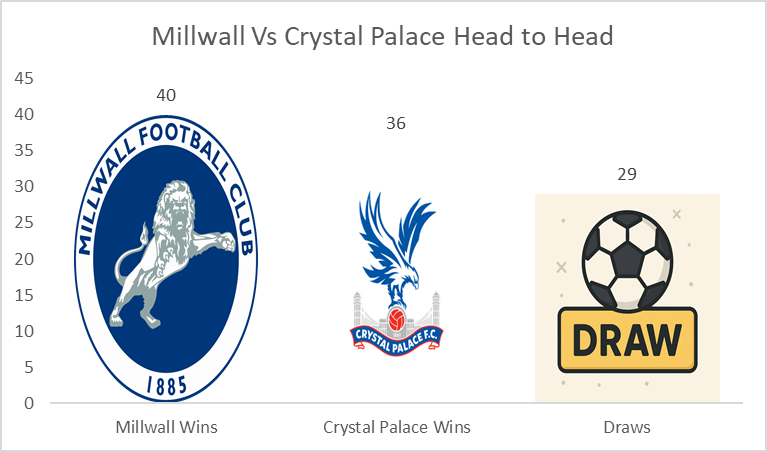
Key Statistical Notes
- First Competitive Meeting: October 31, 1910 (Crystal Palace 3-0 Millwall, PFA Charity Fund).
- Most Recent Competitive Meeting: March 1, 2025 (Crystal Palace 3-1 Millwall, FA Cup).
- Largest Victory (Millwall): Millwall 6-0 Crystal Palace (March 28, 1925, Third Division South).
- Largest Victory (Crystal Palace): Crystal Palace 5-0 Millwall (September 27, 1924, Third Division South).
2. Millwall vs. Charlton Athletic: The Closest Neighbours
Another intense rivalry, particularly given the close proximity of their respective grounds, The Den (Millwall) and The Valley (Charlton), which are less than four miles apart. This derby often pits East South London against South East London. The historical record between these two is tight, with Millwall generally holding a slight advantage. The financial difficulties of Charlton in the late 1980s, which saw them ground-sharing at Palace’s Selhurst Park, added another layer of complexity and occasional bitterness to these local encounters.
Head-to-Head Competitive Record
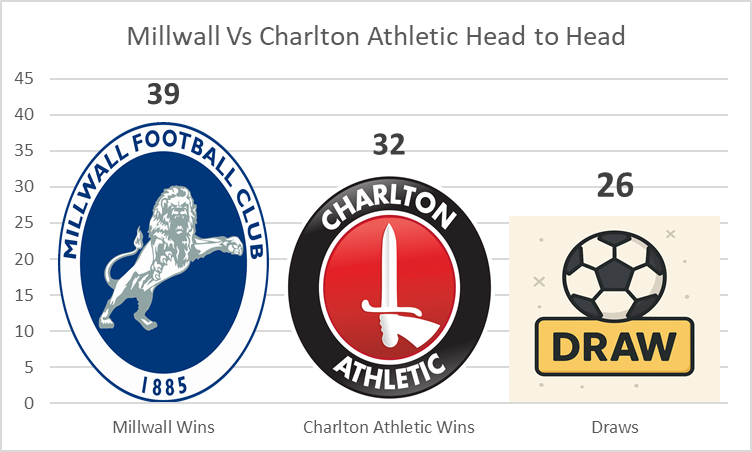
Key Statistical Notes
- First Competitive Meeting: November 26, 1921 (Millwall 0-0 Charlton Athletic, Third Division South).
- Most Recent Competitive Meeting: November 12, 2024 (Charlton Athletic 1-0 Millwall, EFL Trophy).
- Largest Victory (Millwall): Millwall 6-0 Charlton Athletic (January 3, 1931, Second Division).
- Largest Victory (Charlton Athletic): Charlton Athletic 5-1 Millwall (September 2, 1950, Second Division).
3. Crystal Palace vs. Charlton Athletic: The SE London Clash
While perhaps not as historically volatile as the Millwall derbies, the clashes between Crystal Palace and Charlton Athletic are still keenly contested. Both clubs share South East London roots, and their competitive meetings have often been significant in their respective league campaigns. Palace fans tend to consider Brighton & Hove Albion as their main rivals, but Charlton remains a significant local opponent.

Head-to-Head Competitive Record
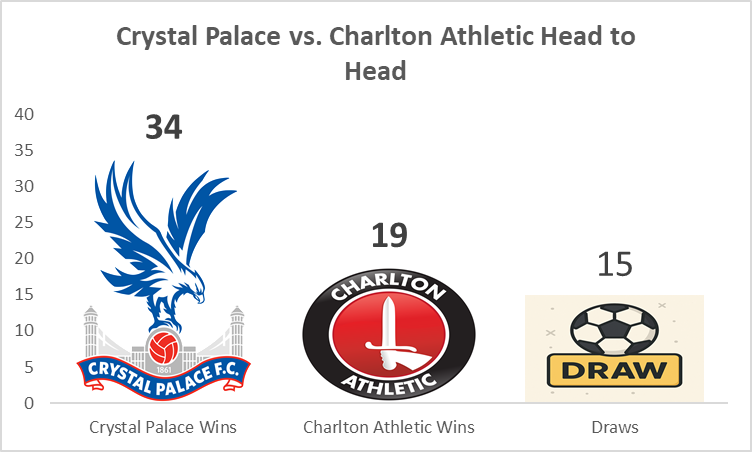
Key Statistical Notes
- First Competitive Meeting: November 14, 1925 (Charlton Athletic 1-1 Crystal Palace, Third Division South).
- Most Recent Competitive Meeting: September 23, 2015 (Crystal Palace 4-1 Charlton Athletic, League Cup). The teams have not met in a competitive league match since the 2012-13 Championship season.
- Largest Victory (Crystal Palace): Crystal Palace 5-0 Charlton Athletic (November 5, 1927, Third Division South).
- Largest Victory (Charlton Athletic): Charlton Athletic 4-1 Crystal Palace (March 27, 1926, Third Division South).
A Rich History and Shifting Fortunes
The history of South London derbies is a tapestry woven with memorable matches, dramatic turns, and periods of dominance for each club.
- Early Days: Millwall, founded in 1885, predates Palace and Charlton (both founded in 1905). Early encounters between Millwall and Crystal Palace trace back to the Southern League in the early 20th century. Millwall’s move to South London in 1910 solidified the geographical basis for these rivalries.
- Shared League Football: All three major South London clubs (Millwall, Palace, Charlton) entered the Football League in the early 1920s, ensuring regular competitive fixtures. There have even been occasions where four South London teams, including AFC Wimbledon, have competed in the same division, amplifying the local stakes.
- Premier League Eras: Crystal Palace has enjoyed several spells in the Premier League, often elevating them above their South London rivals in terms of division. However, this only serves to make the rare cup ties or league encounters in lower divisions even more charged.
- The Rise of AFC Wimbledon and Bromley: The story of AFC Wimbledon, born out of the controversial relocation of Wimbledon FC, has added another dimension to South London football. Their journey back through the non-league pyramid and into the Football League has created new local rivalries, particularly with Charlton and Millwall when their paths have converged. Bromley’s recent rise into the Football League further expands the network of South London derby possibilities.
Emerging South London Rivalries and Their Statistics:
AFC Wimbledon
- Head-to-Head (AFC Wimbledon vs. Millwall – As of July 6, 2025):
- Total Competitive Meetings: 5
- AFC Wimbledon Wins: 2
- Millwall Wins: 2
- Draws: 1
- Notable: Millwall’s 4-1 FA Cup win over AFC Wimbledon on November 9, 2009, is significant.
- Head-to-Head (AFC Wimbledon vs. Charlton Athletic – As of July 6, 2025):
- Total Competitive Meetings: 16
- AFC Wimbledon Wins: 6
- Charlton Athletic Wins: 5
- Draws: 5
- Notable: Their last league meeting was a 1-1 draw in League One on April 5, 2022.
Bromley FC

Their historic promotion to League Two for the 2024-25 season has brought them into the Football League and the South London derby fold.
- Head-to-Head (Bromley FC vs. AFC Wimbledon – As of July 6, 2025):
- Total Competitive Meetings: 4
- Bromley FC Wins: 1
- AFC Wimbledon Wins: 2
- Draws: 1
- Notable: Bromley secured their first Football League derby win against AFC Wimbledon with a 2-0 victory on August 17, 2024, followed by a 1-0 win on March 1, 2025.
- Head-to-Head (Bromley FC vs. Charlton Athletic – As of July 6, 2025):
- Total Competitive Meetings: 2 (excluding U21 matches)
- Bromley FC Wins: 1
- Charlton Athletic Wins: 1
- Draws: 0
- Notable: Charlton Athletic won their recent EFL Trophy encounter 1-0 on November 12, 2024, while Bromley won a friendly 2-0 in July 2016.
Fan Culture and the Essence of the Derby
The South London derbies are characterized by fierce, often vocal, support. Matchdays see a vibrant display of club colours, banners, and relentless chanting. The unique identity of each club – from Millwall’s “No One Likes Us” defiance to Crystal Palace’s passionate “Ultras” and Charlton’s community-focused ethos – adds distinct flavours to the atmosphere.
While the passion is undeniable, and the stakes are high for local bragging rights, South London derbies are generally known for their intense on-field competition rather than widespread fan violence, though isolated incidents can occur, as with any passionate rivalry.
For fans in South London, these derbies are more than just a game; they are a fundamental part of their identity and connection to their local area. The results are discussed for weeks, influencing workplace banter, family dynamics, and local pride. They represent a microcosm of London’s rich and diverse footballing landscape, where loyalty to one’s local club burns brightest.

