
The Merseyside Derby is one of the most famous and exciting football matches in England. It’s when Liverpool FC and Everton FC play against each other in what many consider the most unique rivalry in world football. Both teams are from the same city – Liverpool – and they’ve been fierce competitors for over 130 years, creating countless memories and moments that have shaped English football history.
Image Source
How The Merseyside Derby Started
The fascinating story of the Merseyside Derby begins in 1892, not with two rival clubs, but with a dramatic split within a single team – Everton Football Club. Back in those days, Everton had been playing at a stadium called Anfield since 1878. The ground was owned by John Houlding, a successful brewer and politician who also served as the club’s president.
Everything seemed fine until money became an issue. Houlding wanted to increase the rent he charged Everton for using Anfield, and he also proposed buying the stadium outright. The majority of Everton’s committee members strongly disagreed with these demands, believing they were unfair and too expensive for the club to handle.
The disagreement grew bigger and more heated until it became impossible to resolve. Most of Everton’s committee members, players, and supporters made a bold decision – they would leave Anfield entirely rather than accept Houlding’s terms. They walked away from their home and built a brand new stadium called Goodison Park, located just across Stanley Park from Anfield.
John Houlding found himself with an empty stadium and no team to play in it. Not wanting to lose his investment, he decided to create an entirely new football club to fill Anfield – and that’s how Liverpool Football Club was born in 1892.
This incredible origin story explains why the two stadiums are so close to each other (less than a mile apart and you can actually see one from the other) and why the rivalry between the clubs runs so deep. The very first competitive Merseyside Derby took place on October 13, 1894, at Goodison Park, with Everton winning convincingly 3-0, setting the stage for one of football’s greatest ongoing battles.
The “Friendly Derby” – A Unique Kind of Rivalry
People often call the Merseyside Derby the “friendly derby,” but this doesn’t mean the competition isn’t intense or that players don’t desperately want to win. The “friendly” label comes from something very special about Liverpool as a city – unlike many other football rivalries around the world, this one doesn’t divide people based on religion, social class, or geography.
Instead, the rivalry splits right down the middle of Liverpool families. It’s completely normal for:
- Brothers and sisters to support different teams
- Parents and children to cheer for opposite sides
- Husband and wife to wear different colored shirts on match day
- Best friends to have completely different loyalties
- Workmates to spend weeks teasing each other after their team wins
In the early days of football, before modern all-seater stadiums existed, it wasn’t unusual to see Liverpool and Everton fans standing side by side on the terraces, watching the match together despite supporting different teams. This created a unique atmosphere that you couldn’t find anywhere else in football.
What Caused The Division?
The most powerful example of this special bond came during one of the darkest moments in football history. In 1989, the Hillsborough disaster occurred during an FA Cup semi-final, resulting in the tragic deaths of 97 Liverpool supporters. The entire city of Liverpool came together in grief, and Everton fans showed incredible support for their neighbors. Blue scarves were laid alongside red ones, Evertonians attended vigils and memorial services, and the whole community united in demanding justice for the victims.
Just weeks after the tragedy, Liverpool and Everton met in the FA Cup Final at Wembley. This match became much more than a football game – it was a symbol of the city’s strength and unity in the face of unimaginable sadness. Both sets of fans supported each other, and the match represented healing and solidarity rather than just competition.
However, the modern era has tested this “friendly” reputation. As football has become a global business with enormous amounts of money involved, and as both clubs compete for Champions League places and major trophies, the intensity on the pitch has increased dramatically. The Merseyside Derby now holds an unfortunate record – it has produced more red cards (players being sent off) than any other fixture in Premier League history, with 25 dismissals so far.
Despite this increased intensity during matches, the underlying cultural connection within Liverpool ensures that the derby maintains its special character. Win or lose, families still sit down for Sunday dinner together, and the city continues to show that football rivalry can coexist with mutual respect and community spirit.
Statistics and Records of The Merseyside Derby
As of August 2025, the statistical battle between these two great clubs tells a fascinating story of competition, dominance, and dramatic swings in fortune.
Overall Head-to-Head Record (All Competitions)
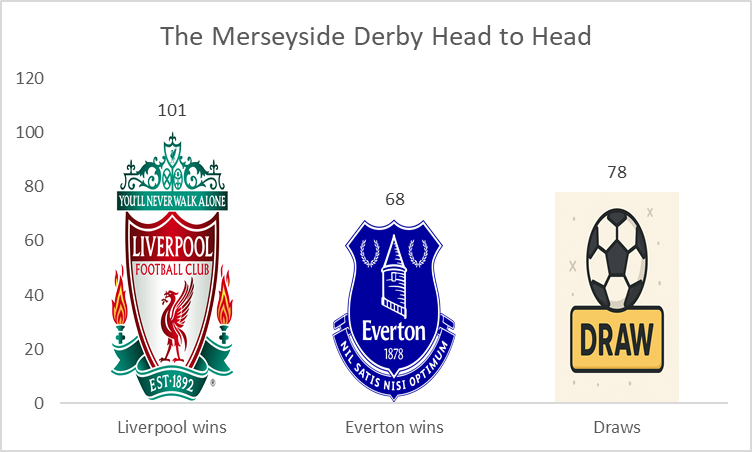
The teams have now faced each other 247 times in competitive matches, making it one of the most frequently played rivalries in English football history:
Premier League Era Performance
In the Premier League era, Liverpool have lost just 11 of the 65 meetings – winning 28, showing their recent dominance. They have still not suffered defeat at home to the Toffees in front of a home crowd since 1999, which demonstrates the psychological advantage Liverpool has developed at Anfield.
Most Recent Encounters (2024-2025 Season)
The 2024-25 season provided more dramatic moments in this storied rivalry:
- February 12, 2025: Everton 2-2 Liverpool at Goodison Park – this was the final derby at Goodison after 131 years, ending with 41 wins apiece at the historic ground
- April 2, 2025: Liverpool 1-0 Everton at Anfield, with Diogo Jota scoring the winner
The Merseyside Derby Goal Scoring Legends
The derby has produced some incredible individual performers:
- Ian Rush (Liverpool): 25 goals – the undisputed king of derby goals, whose clinical finishing terrorized Everton for over a decade
- Dixie Dean (Everton): 19 goals – Everton’s legendary striker from the early 20th century, still remembered as one of football’s greatest goal scorers
- Steven Gerrard (Liverpool): 10 goals – the local hero who seemed to save his best performances for the biggest occasions
- Mohamed Salah (Liverpool): 6 goals – the modern Egyptian superstar who continues to find the net against Everton with remarkable consistency
Appearance Records
- Neville Southall (Everton): 41 appearances – the Welsh goalkeeper holds the record for most derby appearances, representing Everton’s defensive resilience across multiple decades
- Jamie Carragher (Liverpool): 30 appearances – the passionate local defender who embodied Liverpool’s fighting spirit
Historic Matches That Defined The Merseyside Derby
The Merseyside Derby has produced countless unforgettable moments that have become part of football folklore. These matches show why this fixture is considered one of the most compelling in world football:
Football league First Division
1984 League Cup Final – “The Friendly Final” Liverpool defeated Everton 1-0 in a replay at Wembley, but what made this match special was the atmosphere. Both sets of fans celebrated together before and after the game, with many families having members supporting both sides. It perfectly captured the unique spirit of Merseyside football.
1986 FA Cup Final – Liverpool’s Double Liverpool completed a historic league and FA Cup double by beating Everton 3-1 at Wembley. Ian Rush scored twice in a dominant display that showed Liverpool at their absolute peak. This match demonstrated how the derby could decide major trophies.
1989 FA Cup Final – Healing After Tragedy Played just weeks after the Hillsborough disaster, this match was about much more than football. Liverpool won 3-2 after extra time, with Ian Rush again scoring twice, but both sets of fans supported each other throughout. The match became a symbol of the city’s strength and unity.
1991 FA Cup Fifth Round Replay – The Greatest Derby Ever Many people consider Everton 4-4 Liverpool to be the greatest derby match of all time. Liverpool kept taking the lead, but Everton refused to give up, equalizing four times in an absolutely thrilling encounter. Tony Cottee scored a last-minute equalizer to complete one of the most dramatic comebacks in football history. The match was so emotionally draining that Liverpool manager Kenny Dalglish resigned just two days later, unable to handle the pressure anymore.
Premier League
2001 – McAllister’s Miracle With Liverpool reduced to 10 men at Goodison Park, the match seemed to be heading for a draw until Gary McAllister stepped up to take a free kick 44 yards from goal. Nobody expected him to shoot from such a distance, but his perfectly struck effort sailed over goalkeeper Paul Gerrard and into the net. It remains one of the most audacious and memorable goals in derby history.
2018 – Origi’s Last-Minute Madness In the 96th minute of a tense match at Anfield, Everton goalkeeper Jordan Pickford made a catastrophic error, fumbling the ball directly to Divock Origi, who calmly finished to win the match for Liverpool. The goal sparked wild celebrations and showed how derby matches can change in an instant.
2021 – Everton’s Long-Awaited Victory After not winning at Anfield since 1999, Everton finally broke their hoodoo with a significant 2-0 victory. The win meant everything to Everton fans who had endured years of disappointment against their neighbors.
2025 – The Final Goodison Derby The February 2025 match ended 2-2 and marked the end of an era, being the final derby played at Goodison Park after 131 years. Starting from the 2025/26 season, Everton now play their home matches at Hill Dickinson Stadium, beginning a new chapter in the rivalry’s history.
Legendary Players Who Shaped The Merseyside Derby
Throughout its long history, the Merseyside Derby has been defined by exceptional players who rose to the occasion and created moments of magic that fans still talk about decades later.
Liverpool Legends
Ian Rush remains the undisputed king of the derby, with his 25 goals representing a record that may never be broken. The Welsh striker had an almost supernatural ability to find the net against Everton, scoring crucial goals in cup finals and league matches that often decided the outcome of the fixture.
Steven Gerrard embodied everything special about the derby. Born and raised in Liverpool, he understood what the match meant to the city and consistently delivered his best performances when it mattered most. His 10 derby goals included some absolute thunderbolts that showcased his incredible technique and passion.
Kenny Dalglish influenced the derby both as a player and manager, representing Liverpool’s golden era when they dominated English and European football. His understanding of the game and ability to perform under pressure made him a true derby legend.
Mohamed Salah has brought modern magic to the fixture, with his pace, skill, and clinical finishing causing nightmares for Everton defenders. His 6 goals and overall impact in recent derbies have made him the latest in Liverpool’s long line of derby heroes.
Everton Heroes
Dixie Dean scored an incredible 19 derby goals during Everton’s early success, establishing himself as one of the greatest goal scorers in football history. His aerial ability and finishing were legendary throughout English football.
Neville Southall made more derby appearances (41) than any other player, representing Everton’s resilience and determination across multiple decades. The Welsh goalkeeper was often Everton’s best player in matches against Liverpool, making crucial saves that kept his team competitive.
Duncan Ferguson became a fan favorite for his physical presence and never-say-die attitude. The Scottish striker embodied Everton’s fighting spirit and scored some memorable goals that gave the blue half of Merseyside rare moments of celebration.
Tim Cahill had an incredible knack for scoring important goals against Liverpool, using his exceptional aerial ability and timing to find the net when Everton needed him most.
Major Changes
A significant change has occurred in 2025, as Everton now play their home matches at Hill Dickinson Stadium, while Liverpool continue to play at Anfield. This marks the end of an era where both clubs played within sight of each other across Stanley Park. The new stadium represents Everton’s ambitions for the future, though it also means the loss of Goodison Park’s unique atmosphere that had been part of the derby for over a century.
Cultural Impact and What Makes It Special
The Merseyside Derby stands out globally because it’s woven into the fabric of Liverpool’s identity in a way that few other sporting rivalries can match. The “Red vs. Blue” division isn’t just about football clubs – it’s become part of how the city defines itself.
On derby days, the entire city transforms. Streets fill with fans wearing either red Liverpool shirts or blue Everton colors. Pubs become gathering points for supporters to sing songs, share stories, and build up nervous excitement for the match. The atmosphere is electric but rarely hostile, reflecting the unique nature of this rivalry.
The result of each derby affects conversations in homes, schools, workplaces, and social gatherings for months afterward. Winning the derby provides bragging rights that are treasured until the next meeting between the teams. Losing means enduring good-natured (and sometimes not-so-good-natured) teasing from family members, friends, and colleagues who support the other side.
Both clubs represent different aspects of Liverpool’s footballing soul. Everton, often called “The People’s Club,” prides itself on strong community values, local connections, and a deep historical roots in the city. Liverpool, with its global fanbase, European success, and extensive trophy collection, represents ambition and a winning mentality that has conquered the world.
This dynamic creates a fascinating tension within the city. Everton fans take pride in their underdog status and community spirit, while Liverpool supporters celebrate their club’s achievements and international reputation. Yet both groups share an undeniable love for Liverpool as a city and understand their shared football heritage.
Trophy Comparison: Success Through the Years
Looking at the overall trophy collections provides important context for understanding the rivalry and what both clubs have achieved:
Liverpool FC’s Trophy Cabinet
- League Titles: 20 (19 First Division/Premier League titles + 1 Second Division)
- FA Cups: 8
- League Cups: 10 (English record holders)
- European Trophies: 6 Champions Leagues/European Cups, 3 UEFA Cups/Europa Leagues, 4 UEFA Super Cups, 1 FIFA Club World Cup
- Other Honors: 16 Community Shields
Everton FC’s Trophy Collection
- League Titles: 9 (all First Division)
- FA Cups: 5
- European Trophies: 1 European Cup Winners’ Cup
- Other Honors: 9 Community Shields
While Liverpool has achieved greater success, particularly in recent decades and in European competitions, Everton’s nine league titles and five FA Cups establish them firmly among England’s most historically successful clubs. The gap in European achievements reflects Liverpool’s golden periods in the 1970s and 1980s, and again in recent years under Jurgen Klopp.
Liverpool recently celebrated their 20th English league title win in April 2025, adding another chapter to their success story and giving their fans even more reasons to celebrate in future derbies.
The Modern Era: Intensity and Change
Today’s Merseyside Derby retains all the passion and importance of previous generations while adapting to modern football’s demands. The stakes have never been higher, with Champions League qualification, European places, and massive financial rewards depending on league position.
The physical intensity has increased significantly, as evidenced by the 25 red cards shown in Premier League derby matches – more than any other fixture. Players understand that derby performances can define their legacy with fans, leading to committed (and sometimes overly aggressive) displays.
Social media has added new dimensions to the rivalry, with fans from around the world participating in the buildup to each match and celebrating (or commiserating) about the results online. The global reach means that derby day is now a worldwide event, watched by millions of people who may never visit Liverpool but have adopted one of these clubs as their own.
The Future of the Derby
As both clubs continue to evolve, the Merseyside Derby remains as important as ever. New generations of fans are discovering the magic of this fixture, while longtime supporters pass down their loyalty and passion to children and grandchildren.
The rivalry continues to produce new heroes, memorable moments, and dramatic matches that add to its incredible history. Whether it’s a last-minute winner, a spectacular goal, or simply the sight of two sets of passionate fans creating an amazing atmosphere, the Merseyside Derby consistently delivers everything that makes football the world’s most popular sport.
Conclusion
The Merseyside Derby represents something bigger than football. It’s a celebration of community, tradition, passion, and the power of sport to bring people together even as it divides them into competing camps. It shows that rivalry can coexist with respect, that competition can strengthen rather than weaken community bonds, and that football can be both intensely local and globally appealing.
From its remarkable origin story of one club becoming two, through its evolution into the “friendly derby,” to its current status as one of world football’s premier fixtures, the Merseyside Derby continues to captivate fans around the globe. It reminds us why we fell in love with football in the first place – for the drama, the passion, the unpredictability, and the simple joy of supporting your team against your neighbors.
Every time Liverpool and Everton take the field against each other, they’re not just playing for three points or a trophy. They’re continuing a story that began over 130 years ago, adding new chapters to one of sport’s greatest rivalries, and proving that some traditions are too special to ever fade away.

